Showing posts with label 2012-2013 Winter Forecast. Show all posts

Saturday, November 3, 2012

Early November Winter Thoughts

"This winter and last winter will be polar opposites once everything is set and done."


Hello everyone, and thank you for viewing my Early November Winter Thoughts. This is essentially my latest forecast for this winter, although it will not hold forecast graphics. If those are requested and I am able to fit time into my increasingly-busy schedule, I will make them.

ENSO

We'll start off with the El Nino-Southern Oscillation, or ENSO. The ENSO phenomenon involves water temperatures in the Equatorial Pacific, specifically to the west of the South American coast. The ENSO has two stages, a positive (El Nino) and a negative (La Nina). The water temperatures are warmer than normal and cooler than normal in the Pacific, respectively. Let's take a look at the latest ENSO chart:

The chart we want to check out is the bottom one, the temperature anomalies. As you can see, the waters just off the coast of S. America are pretty varied, not really putting up a definitive phase as far as El Nino or La Nina goes. Further out west, near the 180 line, we see a large body of warmer than normal waters. This is what is referred to as a west-based El Nino. You're probably wondering what West-based means.

This is an animation of the west-based and east-based phases of the El Nino and La Nina. The charts define temperature anomalies. The difference between west and east based is that in a west-based ENSO phase, the coldest/warmest waters of a La Nina/El Nino are located to the west, near the 180 line. The east-based phase holds the anomalies near the coast of S. America.

The animation above spells out a West-based El Nino as having cold temperatures in the Eastern US and warmer than normal temperatures across the Western US. That said, if we were to only rely on the ENSO for winter forecasts, one would anticipate a cool East US and warm West US.

Unfortunately, the atmosphere is equivalent to the biggest puzzle in the universe, controlled by so many recognized and unrecognized factors. For now, though, to cover two additional factors, I will copy-paste information from the Final 2012-2013 Winter Forecast that remains relevant to this day.

Effects of a positive AMO on temperatures at the surface


The AMO is called the Atlantic Multidecadal Oscillation. It has a warm phase (positive) and a cold phase (negative), similar to that of the ENSO. In the positive phase, the AMO incites warmer than normal temperatures across the Northern Atlantic, as seen above. These warmer temperatures are reciprocated down into the West US. As of now (and into this winter), we are in a positive AMO.

The AMO is characterized by water temperatures in the Atlantic, hence the Atlantic Multidecadal Oscillation. As stated, the positive phase carries warm temperatures in the northern Atlantic. As I had inferred with the sea ice, or lack thereof, a ridge can set up when the environment is unusually warm. The same goes for the AMO. Notice where the warmest temperatures are found in a positive AMO in the image above- they are found in the waters just south of Greenland and in northeast Canada. This would mean a ridge may very well set up over these areas. And if you know a little something about an index called the 'NAO', you may know that ridging over such areas provides cold air to move south into the Northeast. The same applies to the positive AMO, and that is what we could very well see this winter.


The North Atlantic Oscillation, commonly referred to as the NAO, is a pattern widely recognized by many in the Northeast. A positive NAO brings warm East Coast temperatures and a generally boring storm pattern, while the negative NAO puts on a show and diverts the storm track north. This storm track takes storms down into the Gulf of Mexico, where they gather immense amounts of moisture. From there, the negative NAO takes the storm and shoots it up the East Coast. As the storm system does so, it rapidly strengthens. This strengthening, combined with moisture from the Atlantic, brings intense winter precipitation, ranging from feet of snow to inches of rain in only a couple of days. The AMO has relations to the NAO in that, as a +AMO forms, Arctic waters warm and enhance potential for blocking (high pressure formation) over Greenland, which is a negative NAO.

Something of additional interest is Siberia. Yes, Siberia, Russia. In October, it has been found that the anomaly of snow cover in the Northern Hemisphere can accurately predict the Arctic Oscillation for the North American winter. If we take a look at October's snow cover anomaly we see an overall slightly above normal snow cover rate in the first half of the month, then an explosion of snow in the second half of the month.

This above normal snow cover amounts to the expectation that the Arctic Oscillation will be negative through the winter, especially in the second half. The negative AO provides an opportunity for cold weather to break south into the East US, as well as divert the storm track to the south. As ridiculous as this Siberian theory may seem, it worked last year- below normal snow was seen in October 2011, and look where we ended up for that winter.

Taking into account several other factors that will not be mentioned due to how long this post would end up being, I have come up with the following conclusions for this winter.

•Variable temperatures in December. Snowfall is centered in the East, particularly in the Midwest, Ohio Valley and Northeast.
•January continues a variable trend, but the end of the month brings a brutal chill. Snowfall centered more towards the Northeast.
•February holds brutal cold weather. Midwest, Great Lakes, Ohio Valley, Northeast cash in on snow. Plains also gets in on the action.

These conclusions are very long range and thus prone to 'busting' (not verifying). However, this is my best guess, and I believe that what I typed above is the closest I can get to being correct, based on the latest indices.

REMEMBER: TOMORROW at 12:00 PM CT, you will be able to ask any winter-related questions for 1 HOUR! You will be able to ask here on the blog or on the Facebook page.

Andrew

Tuesday, September 11, 2012

Atmosphere May Be Sabotaging El Nino; Robust Winter Prospects Affected

**First and foremost, this post is dedicated to the victims of the September 11, 2001 attacks at the World Trade Centers, The Pentagon, as well as Shanksville, Pennsylvania. Also in this dedication are the first responders and Good Samaritans who both did or did not survive this tragedy.**

New data has come to my attention that suggests that the atmosphere may be trying to sabotage El Nino at this time.

As I reported in an earlier post, the El Nino is on differing pages as for the sea surface temperatures and the atmosphere. The SST's are showing an El Nino is present, while the atmosphere is not positively responding to such a revelation. Let's take a look at what I have found.

Refresh page if animation stops
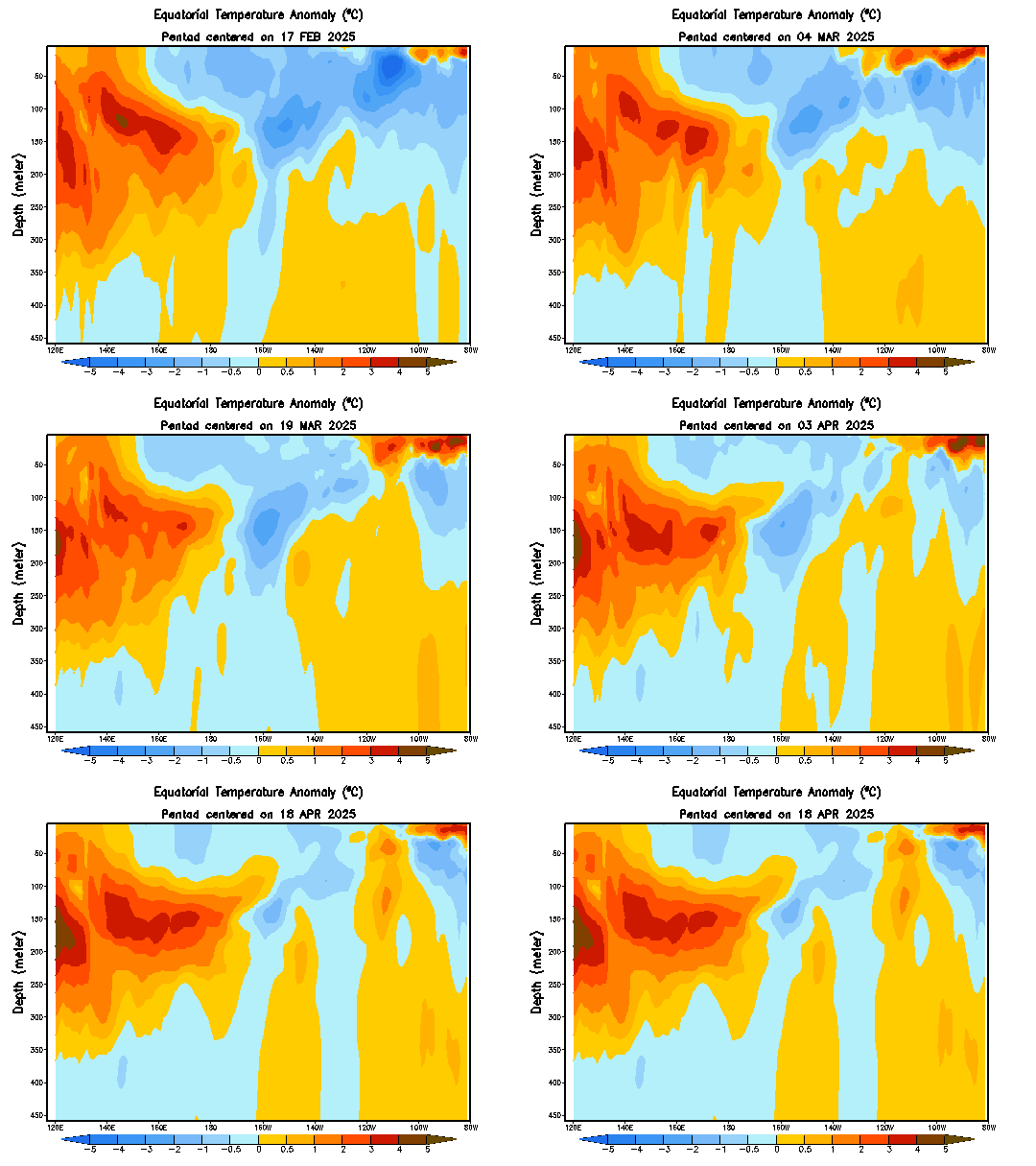
The animation above shows temperature anomalies in the Equatorial Pacific waters, specifically over the ENSO monitoring area. At the beginning of the animation, we can clearly see an El Nino progress upwards from deeper waters, specifically from the 200 meter mark. The main body of warmer waters is centered further to the east, making this a central-east based El Nino.
However, take a look at the last few frames. We can see the warm waters over the central ENSO monitoring regions actually dissipating, and cold water anomalies forming right below this. These cool waters are actually slightly strengthening, posing a big question as to how formidable this El Nino really is. Could the waters be turning on the El Nino in addition to the atmosphere? Will the El Nino even be around for winter? Let's take a look at what the atmosphere says on that subject.


Let's start with 850 millibar wind anomalies. Above is what an El Nino would bring in terms of 850mb wind anomalies to the world. We want to focus in on the equatorial Pacific, where we see above normal wind anomalies in the fall months. That said, if we were to be looking for a sign that the atmosphere is on board with an El Nino, we would want to see stronger than normal winds at the 850mb level. Let's take a look at what 850mb winds are looking like right now.


Latest observed wind anomalies in the region suggest there is nothing significant suggesting that an El Nino is present. The chart above shows pockets here and there of stronger winds, but by the slightest of margins- and they aren't even in the right places! The fact that there are no lower level winds that would be in line with that of an El Nino greatly concerns me, and concerns my confidence in the potential for an El Nino to take hold in the next several weeks.

We can even look at a larger scale of wind anomalies for the world as a whole, and these results only add to the confusion. In what an El Nino would show as normal to below normal wind anomalies in the extreme southern Pacific, the observed wind anomalies depict a much windier than normal environment in that region. Even the typically-calmer than normal winds in southern India in the midst of an El Nino are replaced by strong winds- a bad sign for the El Nino.

Moving on, we can also use something called the OLR, or Outgoing Longwave Radiation, to measure the ENSO phase. In a nutshell, when the OLR is positive, a La Nina is likely to be present. However, in the negative OLR, an El Nino should be found. Let's take a look at the latest observed OLR values for the last few months, as well as the values for the last several days.


Monthly oLR values over the past several months suggest a low confidence level of the atmosphere, with fluctuations from positive to negative being observed from late spring to the current time.  July did have a low OLR which would signal the presence of an El Nino, but August dashed those hopes, with a +0.2 OLR being observed.
Looking at the last few weeks, fears of an un-Nino like environment are confirmed. Throughout the past several weeks, a notable absence of negative OLR values was observed. Positive anomalies were even found where the El Nino should be, conclusive to a lack of atmospheric support to an El Nino.

But wait- There's More!

Courtesy of University at Albany student 'Carl'
The chart above shows precipitation anomalies currently. Typically, we would expect to see above normal precipitation anomalies both in the circled area and just to the north of the same circled area, where the El Nino appears to be based. However, there is no above normal anomalies in the circled region, and only scattered anomalies across the region shaded in orange and red. This lack of widespread precipitation poses a problem to the development of the El Nino. A continued lack of above normal precipitation would lead to additional concerns over how much influence this El Nino could have over the winter.

In conclusion, this new suite of data I have discovered has led me to believe that the atmosphere is not on the same terms as the sea surface temperatures. Additionally, underwater cooling of the same warm water anomalies is only building concern for how far the El Nino can go, especially into this winter.

Climate models are beginning to back off as far as the intensity of the El Nino goes. In my opinion, this is a very wise choice- some further weakening may even be needed going into late fall and winter, as the El Nino is expected to die down further going into that time frame.

As for winter-- The analog year of 2006-2007 that I posted on the earlier referenced post is looking better and better to me, as long range forecasts encourage a stormy pattern over the central and east US, with ridging in the Northwest. Some of you may know a pattern called the LRC, or Lezak Recurring Cycle, and this may be a part of that cycle that is setting up this winter.

Here are the 2006-2007 winter anomalies.


The winter of 2006-2007 was a wet one for the Ohio Valley and Midwest into the Plains. The probability of this exact scenario is unlikely, and there are always additional margins for error with using only one analog year. However, with each day of the atmosphere and SST's differing on the Nino, the prospect for a 'fake' El Nino grows further.

Andrew

Saturday, September 8, 2012

Official 2012-2013 Winter Forecast: Great Lakes

The Great Lakes forecast will only be for precipitation.

I am expecting a snowy winter for the Great Lakes. Based on observations on the stratosphere, the lower strat. is at normal values for this time of year, indicating the possibility of a negative NAO. With the negative NAO, the jet stream buckles and sends frigid air south that typically ignites the lake effet snow machine for those in blue. An El Nino typically does enhance a negative NAO, and this, combined with the favorable stratosphere values, should bring more than a few shots of arctic air southward into the Great Lakes region. Add a couple of degrees above average that the Lakes are currently at, and this winter could be very white.

THIS ENDS THE 2012-2013 REGIONAL WINTER FORECASTS.

Andrew

Official 2012-2013 Winter Forecast: Ohio Valley


The winter forecast for the Ohio Valley, temperature-wise, looks to be on the cool side, especially on the eastern side. An average stratospheric temperature, combined with the recent -NAO trend has me believing that this winter will contain more instances of a negative NAO than we saw last year. Additionally, El Ninos are favorable for negative NAO's, altogether increasing the potential for the North Atlantic Oscillation to be in a negative phase. And that, my friends, leads to below normal temperatures. However, I only highlighted the eastern part of the region, as Nor'easters should pull down cool air from Canada as or after they pass through, lowering temperatures.

The precipitation forecast was not all that difficult. As mentioned above, the NAO is expected to be negative this winter, and this brings the possibility for big coastal storms. Should the big ones bring a wide precipitation shield, I would not be surprised to see the eastern Ohio Valley end up with more precipitation than normal. However, that is not as confident as I would like, as Nor'easters are big storms, and big storms are much harder to correctly predict. However, I have confidence that the negative NAO will bring lake effect snow to the eastern Ohio region, pumping out more snow than normal as the lakes are a few degrees above normal.

Andrew

Official 2012-2013 Winter Forecast: Central Plains

This winter, I am expecting a variety of temperatures in the Central Plains. I expect warm temperatures to keep a safe haven in the northern Nebraska region especially, where the ridge in the Northwest is likely to have some influence on that region. Down towards Arkansas, I am actually anticipating a cooler winter, as a constant sub-tropical jet stream keeps the skies cloudy and generally prohibiting large-scale warm ups. An average stratosphere and negative NAO will help with that.

In the precipitation department, expect wet conditions through winter, as the storm track keeps itself in the South and puts much of the region through a wet winter. The occasional snowfall cannot be ruled out. To the immediate northwest, in northwest Arkansas and southeast Missouri, drier conditions consistent with an El Nino will prevail. As I mentioned in the Midwest forecast, a large storm may be all it takes to wipe out the dry conditions.

Andrew

Official 2012-2013 Winter Forecast: North Plains

Temperature forecasts for the Northern Plains this winter were a little on the tricky side, mainly trying to figure out how far east the ridge in the Northwest will extend. That said, I took a bit of a gamble and went against my analogs in deciding that the Northern Plains may end up warmer than normal. I find it likely that there will be some breaks in that warm trend and cold air will return, but for how long is the question.

In the precipitation department, the lack of a strong jet stream and displacement of that jet stream to the south will end up with a winter below normal. Clipper systems will still come and go, but the lack of stronger systems in the area will prove fatal to hopes for a wetter winter than is typical. I am watching this region closely, as the forecasts are a bit less confident than I would want them to be. That said, this is more of an educated estimate than a forecast at the moment.

Andrew

Official 2012-2013 Winter Forecast: Northwest

There is only one color on this winter's forecast for the Northwest, and that is red. The ridge typically present over the Northwest in El Nino's should strike again and bring the region warmer than normal conditions. because the sub-tropical jet stream will take over much of the work as far as storm track goes, the Northwest will get a break and be warmer than normal in the absence of cooler air being dragged onshore.

A similar story plays out in the precipitation forecast, with a dry winter ahead. As described above, the storm track will be redirected south, and this will easily hamper hopes for a wet winter. A ridge will be in place over the Northwest, helping to disarm any potential precipitation systems.

Andrew

Official 2012-2013 Winter Forecast: Southwest

Temperatures in the Southwest will be relatively normal throughout much of the region, but where there are anomalies, there will be big anomalies. The upper section of the Southwest will get in on warmer than normal temperatures in the presence of the ridge that plagues the region during an El Nino. On the opposite end, area in and around Southern California should end up on the cool side as the constant influx of storm systems pulls in cooler air. This cooler air may extend into the mountains as well.

Precipitation will be abundant in the southern half of the Southwest, with the storm train leaving its mark across the region. Wet conditions will be present in low lying areas, while the mountains should get snowier than normal, thanks to the El Nino and the sub-tropical jet stream. A dry winter is in store for the upper portion of the Southwest, as the ridge in the Northwest deflects precipitation chances and leaves the region high and dry.

Andrew

Official 2012-2013 Winter Forecast: South Plains

Temperature forecasts for the South Plains are relatively unsure, as a ridge in the Northwest could tip the scales for the upper part of the South Plains, but a cool down in the Southeast could also have an effect on the region in question. To be on the safer side, I decided to point the warmth in the north and the cooler weather more towards the Southeast. Be warned, this could go either way.

In the precipitation department, a charged sub-tropical jet stream will get the El Nino going and pump storm systems through the area. Severe weather is also possible with these systems, as the proximity to the Gulf of Mexico and jet stream winds may combine to form at least a couple active days of weather.
I did appoint a dry area of weather, as the Midwest and Ohio Valley's typical El Nino dryness will continue in the northeast reaches of the South Plains. Some icy weather may occur with a cool weather outbreak across the northern part of the nation.

Andrew

Official 2012-2013 Winter Forecast: Gulf Coast

Temperature forecast for the Gulf Coast this winter calls for a cooler than normal season, with a consistent storm track bringing an end to widespread sunshine and thus putting a damper on heating for the areas shown. Analogs I am using also show anomalies of at least 3 degrees below normal for this winter, should everything go as planned. I do not doubt a warmer than normal area in portions of Tennessee, due to the proximity to the Ohio Valley and expectation of a dry winter for them.

As for precipitation, a wetter than average winter will be the case right along the Coast, as the charged sub-tropical jet stream shoots storm systems through that corridor to cause many instances of both rain and severe weather should the set up be right. I put a drier than normal area in the far northwest portion of the region to connect to the Ohio Valley and Midwest expected dryness for the winter.

Andrew

Official 2012-2013 Winter Forecast: Southeast

The temperature forecast for the Southeast is pretty tricky. This winter, we will be in an El Nino which, as of now, looks like it has a shot of being west-based. Should we see a more west-based El Nino, I would expect temperatures to possibly get even cooler than what is shown above.
I am projecting cool temperatures to reign supreme this winter, as consistent storms push down a lot of sunlight that would otherwise heat the ground. Additionally, climatologically, an El Nino supports cooler than normal temperatures in the Southeast. This suspicion is confirmed on my analogs in the national winter forecast issued a half hour ago.
I am watching the potential for a warmer than normal spot of temperatures in the far northwest portion of the Southeast, as dry conditions in the Ohio Valley may contribute a warmer atmosphere to the region.


As for precipitation, the charged and active sub-tropical jet will continuously steer storms up the coast, soaking the Southeast in the process. My analogs for this winter confirm that history shows that situations like these end up wetter than normal for the Southeast. It should be noted that the Southeast may be in line for a severe weather risk, as jet stream winds combine with strengthening storm systems to produce a potentially active situation.
The proximity to the Ohio Valley puts the northwest corner of the region at a disadvantage in the precipitation department, as that region is not favored for heavier precipitation during an El Nino.

Andrew

Official 2012-2013 Winter Forecast: Mid-Atlantic

Temperatures for the Mid-Atlantic this winter should be below normal based on my analogs for this winter. The analogs I have are showing a strong negative NAO, and this will be able to buckle the jet stream and let cold air flow south. Additionally, the Southeast ended up cooler than normal in the analogs I am using, enhancing the probability that the entire East US will end up below normal in the temperature department.

As for precipitation, persistent coastal storms from a strong sub-tropical jet stream will enable the Mid-Atlantic to end up snowier than normal. A persistant negative NAO has led the stratosphere to average levels, which, unlike last year, will enable better chances for snow and cold in the Eastern US. In more inland areas, it can be expected that more of an ice risk will develop, thanks to warmer air in the South, combined with cool air from the North.

Andrew

Official 2012-2013 Winter Forecast: Northeast

Temperatures for the Northeast are expected to remain below normal this winter, as an El Nino sets up. The El Nino will strengthen the sub-tropical jet stream, which will then curve up the coast with strong coastal storms. These coastal storms will draw cold air down from Canada, and potentially keep it in place after the storms leave. Should a persistent negative NAO develop, this forecast may be even cooler than shown. Analogs I used in the national Official 2012-2013 Winter Forecast show a strong west-based negative NAO that would ensure cold and snow would frequent this area.

As for precipitation, this winter looks to be planning a beating for the Northeast, with my analogs and personal knowledge of El Nino's combining to make this winter one many will not forget soon. I am projecting the Northeast to be a snow haven, as the sub-tropical jet catches weak storms and 'bombs' them out as they travel up the East Coast.
I am not ruling out the occasional ice storm in parts of the southern Northeast, as warm air in the South may mix in with the cool air being pulled south by the coastal storms.

Andrew

Official 2012-2013 Winter Forecast

This forecast is old.
CLICK HERE for the new one.

"They say revenge is a dish best served cold. This winter, the East Coast gets its revenge."


Hello everyone, and welcome to the 2012-2013 Official Winter Forecast. Keep in mind this is not the final forecast, which will be issued later in the fall if it is necessary.

***WARNING: This forecast is a long one. If you do not want to read through all the technical information, skip to the point where it says 'STOP HERE'.***

We will start out with an ENSO update and go from there.

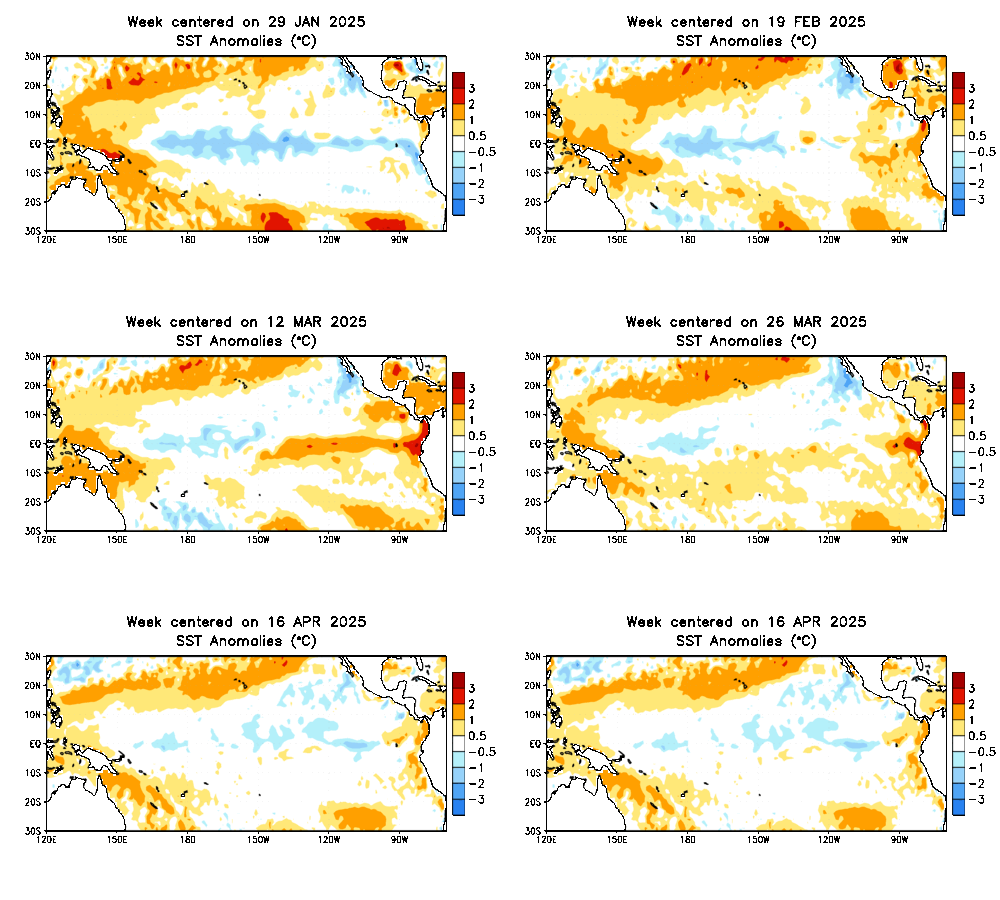
The loop above displays sea surface temperature anomalies in recent months over the ENSO monitoring areas. For those less experienced, warm anomalies west of South America indicate an El Nino, while cool temperatures show a La Nina.
In recent months, we have seen a warming trend begin in the eastern and central portions of the ENSO monitoring area, also known as Nino 1+2 (eastern) and Nino 3.4. If we were in winter, this would have been a mainly east-based winter. However, as time progressed over the past few months, the trend of warming has been shifting westward into more central regions of the ENSO area, and even more recently, warm anomalies have been dangerously close to the 180 line, which, in my opinion, would clarify the presence of a west-based El Nino.

Refresh page if animation stops.
Underwater sea surface temperature anomalies can be used in coordination with the actual surface temperature anomalies, mainly to see if this is a widespread underwater warming/cooling or strictly a surface-based anomaly. In this case, we have seen a significant warming trend in the eastern ENSO region, with a very slight progression west with time on the surface.
Despite the slight progression west, I believe that we remain in a mainly central-based to possibly west-based El Nino at the time of publishing. However, I am closely watching that warmer than normal body of water in the western ENSO region to see if it will do anything.

Also able to detect if and where an El Nino may be is a graph of the SST anomalies across the ENSO regions. From top to bottom, they go from west to east in the ENSO regions. The charts above show distinct warming earlier in the year across eastern portions of the monitoring regions, but recently those have seen a drop off. However, the Nino 3.4 and Nino 4., both of which had had some trouble warming, have recently seen a period of sustained warming- a good sign for a central or west-based El Nino.


Animation obtained from usmessageboard
Original graphics made by ESRL
Many of you may be wondering 'What is the difference between west based, central, east based El Ninos?' Well, as shown in the animation above, an East-Based El Nino will have a very warm majority of the nation, centered in the western half of the country. On the other hand, a west-based El Nino will bring a cooler than normal anomaly to the general Eastern US, intensifying on the East Coast. So, if you want to see some cold and snow, I suggest you start rooting for a west-based El Nino to get going.

Something else I look at to see how the El Nino is doing is an index called the OLR, or Outgoing Longwave Radiation. In a nutshell, OLR measures the anomaly of convection over the ENSO monitoring area. When there is more convection than usual in the ENSO regions (El Nino), the OLR will turn negative. When the regions are quieter than normal, we will see a positive OLR reading.
In the past few months, we have seen a drop-off from a positive OLR to a relatively neutral phase. This is to be expected, considering we are switching from a La Nina to an El Nino. However, in July, the OLR saw a pretty hefty drop of -0.7, which essentially indicates we have entered an El Nino. Considering a lot of warming did occur in July, as seen on the animations above, this is no surprise. The question is, can the OLR stay below normal?
I believe that we should see a below normal OLR (above normal convection) as long as we have that warm body of water circulating in the ENSO monitoring regions. And that is good, because that warm body of water looks to be ready to stay.

The stratosphere- as far above our heads it may be- provides significant help for winter forecasting. The stratosphere graphs, like the one shown above, run from 1mb to 70mb, with 70mb being closest to the surface. To be the most accurate, I have chosen the 70mb chart to help forecast the winter.
In recent months, the stratosphere has seen a period of below normal temperatures, followed most recently by a jump back to normal anomalies. This jump to normal can be thanked by the NAO, which will be discussed later.
Typically, a cold stratosphere in winter will mean a warm nation, and a warm stratosphere will allow cold air to flow south into our neck of the woods. Last year, we had a very cool stratosphere until mid-late winter, when something called a 'Sudden Stratospheric Warming' event, or SSW, occurred. These Sudden Stratospheric Warming events are supposed to happen in winter, which signals the atmosphere's turn to being prepared for spring. It should be noted that SSW's are supposed to occur every winter to make ready for spring. But last year, we just didn't have a significant one.
Looking back at the summer conditions in 2011, we saw a somewhat below normal anomaly going into fall in the stratosphere, which could have been a tip-off to that winter. This summer, we have seen mainly normal anomalies, which puts me in a better place, mentally, as to this upcoming winter, as the stratosphere may not have as much trouble with warming as it did last winter.

Of additional significance is something called the Pacific Decadal Oscillation, or the PDO. The PDO can, and commonly does match up with different phases of the ENSO regime. That will de discussed later, however.
The image above shows 1 month changes in sea surface temperature anomalies across the globe, but we are focusing on the North Pacific. We are currently seeing what could be a cooling trend over the North Pacific. I am not sure yet, because there is a wide expanse of warm water over the North Pacific as well. However, look at the Gulf of Alaska's coast. There is a sliver of warmer than normal temperature anomalies along the Alaskan and Canadian coasts. This could bode well for a positive PDO, which generally gives a cooler than normal touch to the Eastern US for the winter, and a warm and dry feel over the Northwest and Western US. But what is a positive (and negative) PDO characterized by?

In a positive PDO, we see warm waters along the Gulf of Alaska's Alaskan and Canadian coasts, even down into the West Coast of the US. What the positive PDO is really composed of is the cooler than normal waters extended basin-wide over the North Pacific. These cooler waters are the component of the positive PDO. As paradoxical as it sounds, the cool waters show the warm PDO.
Notice the warm water anomalies over the Pacific Equatorial region. This is actually an El Nino, which leads one to seeing that an El Nino and Positive PDO seem to go hand-in-hand. That said, climatologically, it would be favored to have a positive PDO present with an El Nino. It's not for sure, but is more prone to happen over a negative PDO.
In a negative PDO, we see a wide swath of warmer than normal temperature anomalies over the North Pacific, with a bit of cooling near the Alaskan and Canadian coasts, essentially opposite of a positive PDO. Note the cooler than normal waters in the Equatorial region, signifying the presence of a La Nina. Again, climatologically, a La Nina and Negative PDO will go together.

If a positive PDO were to develop this winter, it would essentially emphasize the effects of the El Nino- warm and dry in the Northwest, with cool and wet conditions being found in the Southeast. At this point in time, after looking at conditions in the Pacific in the Southern Hemisphere, as well as animations of the entire basin, it would appear that we may have a negative PDO on our hands this winter. Let's take a closer look below at how that could happen.

The areas I have circled have seen a warming trend in the past 5 weeks of Sea surface temperature monitoring. This warming has encompassed the waters off eastern Asia, as well as almost the entire basin of the Southern Hemisphere portion of the Pacific. Some warming can also be seen to the south of the first mentioned warming area in East Asia.
If we look to the PDO phases listed above, we see that a cool phase, or Negative PDO, is defined by warm waters reaching across much of the Pacific from Eastern Asia. This warming continues moving south, and is reinforced in the Southern Hemisphere's part of the Pacific. If we look at the map above, I can see that solution working out better at the moment, more-so than a Positive PDO. That arm of warm waters looks a bit too strong to be overcome by cooler anomalies in the Northern Pacific. Remember this section for later on.

One can also use recent precipitation trends to see where the most precipitation can be found. While these trends are likely to be more accurate in the fall, I think I can map out a few key points.
Notice the Gulf Coast and East Coast are both relatively OK in the midst of this horrible drought. This could very well be a sign of the El Nino that has taken hold, as El Nino's tend to keep the mentioned regions on the wet side. However, recently the Great Lakes and Ohio Valley regions have been receiving precipitation, and this could be a sign in terms of what could be upcoming for this winter- a period of dry weather followed by a cool down and precipitation. However, I would not bank on any of this until the fall.

Getting a bit more regional, Notice the Great Lakes temperature anomalies in this image. The lakes are all 4 to 8 degrees above normal. Considering they are this warm and we haven't even gotten to fall yet, I would see this as a very good sign for those who live in the lake effect snow regions. If favorable winds arise and cold air comes down from Canada, we could see more than a few major lake effect snow events, should the Lakes remain as warm as they are today.

And now, the moment you've all been waiting for... ANALOGS.
Remember that analogs are not my forecast, and are simply a tool to assist me in making my forecast.

This time around, I started out with all years that had a weak-mod El Nino, disregarding where it's based or whether or not it came after a double-dip La Nina like we just had. That said, here are the analogs from all weak-moderate El Nino years.

Temperature anomalies for my set of analogs resulted in a much cooler than normal Southeast and cooler than normal Eastern US in general. Additionally, the Upper Midwest to the Northwest regions were warmer than normal. If you look closely at the loop above referencing the different bases of El Nino's, you would see that this image looks a lot like what would be expected from a West Based El Nino. Coincidence, or a sign of what's to come?

Precipitation anomalies for the same set of years were not too significant. You can point out the El Nino signatures, with above normal precipitation anomalies across the Southeast and portions of the East Coast, as well as a wet Gulf Coast. The El Nino also makes its mark in a wet Southwest and dry Northwest. However, the below normal anomalies that one would expect to see in the Ohio Valley have been shifted south. It's not a huge shift and nothing to be concerned about, in my opinion.

We are still on the same set of years. This shows 500mb height anomalies for all weak-moderate El Nino years. We can see a very stormy pattern set up across the nation, specifically encompassing much of the East Coast. From this signature, one can determine the track of the jet stream as well. Also of note is the ridge up in Canada that is very close to Greenland. I find it possible that this influenced a negative NAO thanks to that ridge.

Now that we have examined all weak-moderate El Nino years, see where each one was 'based'. Now, because cooler than normal anomalies are surfacing in the Nino 1+2 region this year, I am going to take out analog years that were east-based.

1951-1952: East Based
•1957-1958: Central Based (DISCOUNTED- TOO STRONG)
•1963-1964: Central Based
•1965-1966: Central Based
•1968-1969: West-Central Based
•1976-1977: East-Central Based
•1977-1978: Central Based
•1991-1992: Central Based (DISCOUNTED- TOO STRONG)
•1994-1995: West Based
•2002-2003: Basin-Wide
•2004-2005: West Based
2006-2007: Basin-Wide (Mainly East Based)
•2009-2010: West-Central Based

Following 'Round 1' of eliminations, we now have 9 analog years.
Next, we're going to eliminate years that started an El Nino before June. It should be noted that the site I use to determine this puts months into 3-month columns. Thus, I must determine the single month from that data.

•1963-1964: Began in May
•1965-1966: Began April-May
•1968-1969: Began in July
•1976-1977: Began in August
•1977-1978: Began in August
•1994-1995: Began in August
2002-2003: Began in April
•2004-2005: Began in June-July
•2009-2010: Began in June

At this point, we now have 6 analog years. These 6 years are comprised of central or west-based weak-moderate El Nino's that began in or after June. Let's see what temperature and precipitation anomalies these bring up.

This time around, my analog years show a much cooler nation, hitting the Southeast and Ohio Valley especially hard. The Northern Plains and portions of the Northeast also get in on the coolness. Despite this, much of the Western US is warmer than normal, likely due to a ridge over the area as you will see below.

In precipitation anomalies for those same years, a wetter than normal Southwest is observed, due to the continuous barrage of low pressure systems across the region. At the same time, the Northwest is drier than normal due to the lack of the barrage of disturbances. Nothing too significant is found in the Eastern US, although by the spotty above normal precipitation anomalies, I would consider the Gulf Coast and East Coast slightly wetter than normal. There remains a drier than normal region, centered just north of the Gulf Coast that makes an attempt to stretch into the Ohio Valley. Whether that happens remains to be seen.

Next, for the same 6 years, this is the 500mb height anomalies. You can see a stormy pattern across the North Pacific into the West Coast, and a very stormy pattern in the East US. However, notice the large high pressure area over western Greenland into eastern Canada. This is a west-based negative NAO, the jackpot for Northeast snow lovers. The west-based negative NAO buckles the jet stream through the Northeast to provide abundant cold weather. Additionally, the storm track will shift in a position favorable for heavy snow throughout the East Coast, particularly the Northeast.

However, remember what I said about there being a better possibility for a Negative PDO this winter than a Positive PDO? Well, I was able to track down a website that sorts ENSO years into tables in correlation with that year's respective PDO phase (click here). I have decided to find the years that are comprised of an El Nino and Negative PDO. This is the year I found in those tables that is included in my analogs already shown above.

•1968-1969

Because it is also listed in those tables, I am going to double-weight (type it in twice) it when the final set of analogs are shown.
Next, I looked at years that had an El Nino following a double-dip La Nina. The year(s) that fit into this category as well as my analogues I already have included:

•1976-1977
•2009-2010

Technically, 2009-2010 was not a double-dip La Nina, but a closer examination of the ONI index reveals that it truthfully was a continuous double-dip La Nina. Like before, both of these years will be double-weighted in the final analogues.
Now that we have our final analogues, here is what they look like:


For temperatures, my analog years show a very cool Eastern US, hitting the Southeast particularly hard, where temperature anomalies bottomed out at nearly 4 degrees below normal. These cool temperatures extended back to the Ohio Valley as well as the Midwest and Northeast. Also hit by the cool down were the Northern Plains and Great Lakes.
On the warm side was much of the Western US, and maybe the very tip of the New England area.
Because this is an El Nino, I don't trust the cool anomalies in the Northern Plains too much, but the whole scenario is based on history, so I can't argue with that.

Precipitation anomalies were not all that exciting, with a fairly wide expanse of slightly below normal precipitation across portions of the Southeast into the Ohio Valley. Wetter conditions were found in the Southwest, thanks to the train of storm systems, and these wet anomalies were reciprocated on the Gulf Coast. While it is not shown, I believe the Northeast will have a stormy winter, as is typical in an El Nino.
The Northwest ended up much below average in precipitation, as the lack of storm systems in that area hit precipitation totals hard.


Lastly, 500mb height anomalies for these years in the winter time were overall pretty stormy. A swath of below normal heights covered the entire nation, with much below normal heights registering in over the Eastern US, especially the Mid-Atlantic.
Notice the very strong high pressure ridge over southwest Greenland. This is indeed a negative NAO, as I had described in the last set of analogs. However, notice how it is west-based and strong. Too strong of a negative NAO can be harmful to snowfall totals for the Northeast. However, I took a look at other precipitation variables for these years and discovered that the storm track still curved into the Northeast and gave a big-time hammering to the East Coast.

**STOP HERE**

After all of the above is set and done, I present to you The Weather Centre's Official 2012-2013 Winter Forecast.

I believe the winter will end up mainly cooler than normal over the Northeast and Southeast, as a consistent storm track brings storms up the coast that may be able to bring down arctic Canadian air. There is wiggle room in the Great Lakes, which may be influenced by the El Nino and end up going either warmer or cooler than normal. The Northwest and Northern Plains will likely be warmer than normal as a ridge takes hold over the region. I do not doubt the potential for a few arctic blasts in the Plains, but overall a warm pattern appears to be evolving.

Precipitation-wise, one can expect a wet winter across the Gulf coast and Southwest, as the sub-tropical jet stream heralds in storms over and over again. It should be noted that there is an increased severe weather risk in the Southeast/Gulf Coast region this winter, as the jet stream combines with storm systems and Gulf air to produce strong thunderstorms, potentially on numerous occasions. Using analogs shown above, I did put a 'possible dry conditions' over the southern Ohio Valley, but I'm not confident in that just yet. The Northwest should remain dry due to a lack of incoming storm systems that have been displaced south. The Northeast and Mid-Atlantic will get their more-than-fair share of snow this winter, as countless storm systems barrel through the region and dump more and more snow. Should we see a pouring out of arctic air from Canada, the Great Lakes should end up snowy, thanks to lake-effect snowfall.

The snowfall forecast calls for a snowy time across the Great Lakes if Canadian arctic air is able to push down south and ignite the lake effect snowfall machines. The Northeast will be the hotspot this winter, as many Nor'easters push up the coast and create a chaotic scene in the worst storms. Due to the storm track entering the Southwest, skiing conditions should be better than normal in those areas, while the Northwest stays high and dry due to the lack of a storm track in the vicinity.

I find it possible/likely that the Southeast, Southern Plains, southern Ohio Valley, and Mid-Atlantic regions will share in a good ice storm this winter. While the risk may have to be adjusted a bit farther inland, the areas marked now stand a fair chance of seeing some ice during the wintertime. Nor'easters that begin to rapidly strengthen while still within the warm air holds of the Southern US may be able to pull some cool air into the system and produce a good ice storm in the region delineated above.

Here is the Overall Graphic for the winter forecast.


Thank you for reading the official 2012-2013 winter forecast. If you have any feedback or questions, do not hesitate to ask them below. They will be answered fairly quickly.
Keep in mind this is not the final winter forecast, which will be published in October.

Thanks again for reading!
~Andrew