Monday, August 4, 2014

Notice

After some thinking and analyzation of where the blog is at now, I've decided to go ahead and enlist advertising for The Weather Centre. These adverts will be placed on the sidebar of the blog only, so as not to disrupt the environment of the blog.

I decided to enlist advertising to benefit the blog, and all of you. If I am lucky enough to collect any substantial revenue from these ads, I hope to invest in products to improve the blog's experience. Such investments may include paid model subscriptions, enhanced radar software, and other ventures.

These ads are not meant to be a big source of revenue for me- that's not my intention, at all. These ads are only meant to better the blog as a whole.

Unfortunately, I cannot control the majority of ads that appear on the blog, so I apologize in advance if any are not related to the website, may be controversial, or are just "odd", for lack of a better term.

If you have any concerns or suggestions on these ads, please don't hesitate to voice them, since, at least from my point of view, this may be a rather controversial move.

Andrew

Sunday, August 3, 2014

Arctic Sea Ice, Temperatures Indicative of Winter Ahead

Latest observations of Arctic sea ice anomalies, as well as temperature anomalies, may hint at what's to come this winter.

COI
The above graph shows past records of Arctic sea ice over time, categorized by color, with the key on the bottom left. This year's sea ice observations are shown in the thick black line, while 2013's sea ice observations can be viewed by the orange-colored line. Glancing around this chart, it's quite evident that sea ice anomalies in comparison to recent history are above normal this year. Showing itself more recently, these above-normal sea ice anomalies appear to be eclipsing the observations of 2006, which appears to be the highest areal sea ice coverage minimum in the last ten or so years. This recent slowdown of declining ice coverage indicates the presence of cold air over the Arctic Circle, something that stays in that area year-round. What's more important this time, however, is that the cold air is allowing less ice to melt, which in response provides more cold air, and so on and so forth.

COI
The next chart we will analyze is a graph of observed temperatures in the Arctic Circle. The red line on this graph shows observed temperatures, in units of Kelvin. The green line indicates the average temperature for a given date, and the solid blue line depicts the freezing temperature. Arctic temperatures have remained almost completely below average since this spring, a rather remarkable feat. Temperatures currently are above freezing, as is to be expected for the summer season, but observed temperatures remains below the average temperatures. As we discussed earlier, the presence of cold air and slowing of sea ice melt are likely playing into these below normal temperatures in the Arctic.

To break it all down, these developments tell me the chances of a cold winter ahead are being raised. If we were to see low sea ice levels and warm Arctic temperatures, I'd probably root for a warm winter ahead. However, seeing substantial sea ice presence in the northern Hemisphere, as well as consistently below-normal Arctic temperatures, I believe that these factors could play into the risk of another cold winter ahead.

Andrew

Friday, August 1, 2014

Mid-August Unseasonable Cold Blast Appearing Likely

Yet another blast of unseasonably cold air can be expected, this time around the middle of August.

Tropical Tidbits
The first graphic we will examine shows the GFS model's forecast of 500mb height anomalies over the western Pacific. Blues indicates stormy and cold weather, while reds show warm and quiet weather. This forecast graphic, valid on August 9th, shows a typhoon moving north into the southern portion of Japan. We can identify this typhoon feature by the tight collection of isobar contours, as well as the concentrated nature of the below-normal height anomalies. This typhoon is expected to be weakening as it makes its move north into Japan.

Tropical Tidbits
This next graphic shows the same GFS forecast of 500mb height anomalies, now valid on the evening of August 9th, whereas the first graphic showed the forecast for the morning of August 9th. In this picture, we can still see our typhoon feature, now pulling itself northeast through the main part of Japan. The isobars are no longer as concentrated, and this can be contributed to both weakening of the typhoon, as well as the lower resolution forecasts this GFS model makes after forecast hour 192 (you'll notice that this graphic shows the forecast for hour 204).

Why is all of this significant? The general premise that I've discussed numerous times on this blog, particularly in the wintertime, is that the weather in East Asia can affect our weather here. To clarify, for example, high pressure over Japan would mean high pressure over the US 6-10 days later. Similarly, low pressure over Japan could indicate stormy weather in the US 6-10 days later, and so forth. We can use this rule to our advantage here. We see a strong typhoon hitting southern Japan on August 9th, and tracking through the middle of the country before shooting east into the open Pacific. By using this correlation technique, we can identify that cold weather and a general stormy pattern may be anticipated 6-10 days after this August 9th impact. Do the math, and we can expect an unseasonable cold weather event around the August 15-19 timeframe.

Details still need to be refined, as this is a long range forecast, but the chances are good that cold weather may be expected in the middle of August.

Andrew

Wednesday, July 30, 2014

Fall 2014 Seasonal Forecast

This is the outlook for Fall 2014.

We will begin by analyzing the temperature outlook from a trusted long-range ensemble guidance system.

CPC
For the August-September-October period, the ensemble system shows an outlook of warmer than normal temperatures across the Western US and portions of the Northeast, with darker shadings indicating higher confidence in that forecast anomaly. The warmest temperatures appear to be centered over Montana and Idaho in this outlook, as well as portions of New York and towards Maine. The big story here, however, is the anomalous cold shown in this outlook. We see below normal temperature anomalies extending from the Canada/US border, all the way down to the US/Mexico border. The core of the cold looks to be across the Plains and Midwest, with higher confidence in cold weather displayed by the dark blues. These dark blues look to be most prevalent in the Midwest, Plains, Great Lakes, Ohio Valley and Mid-Atlantic.

CPC
If we fast-forward to the October-November-December temperature forecast, we find a similar outlook as the one we just analyzed for the August-September-October period. In this forecast graphic, we see cold weather forecasted across most of the nation. The cold extends from the Pacific Coast to the Carolinas, with the deepest cold weather displayed over the North and Central Plains, as well as the Southwest US. Most of the coastal Eastern Seaboard looks to be in slightly above normal temperatures, though confidence in this is rather low.

After a cold winter, spring and summer, a cold outlook for fall is something that makes sense. We are still seeing that persistent pool of warm waters in the northeast Pacific, which has allowed these seasons to be so chilly. As a result, we should be wary of a chilly fall this year, something that could continue into the winter.

Let's now examine the precipitation outlook.

CPC
The precipitation outlook for August-September-October from this long range ensemble system has a variety of conditions across the country. We see a general dry trend over the Southwest, unfortunately worsening the already-catastrophic drought in California and other states. The Pacific Northwest is showing a variable signal. The North Plains are exhibiting above-normal precipitation anomalies in rather high confidence for this timeframe, and this trend continues into the Midwest and Great Lakes. A stark dry trend is observed in the Southern Plains with enhanced confidence, and a similar story can be found in the upper Midwest. In the East US, we see mainly variable conditions that cannot let us determine a particular forecast for this area. Beyond this forecast period, the precipitation outlook exhibits too low of confidence to determine a thorough forecast.

Because we don't know what the El Nino situation will do for this fall and winter, it's hard to see how reliable this precipitation outlook is. The drought conditions in the Southwest should allow for a general dry trend there by process of a feedback loop, unless we see a sustained El Nino arise. I do believe we see conditions in the Midwest and Great Lakes a bit drier than they are projected to be, with conditions along the East Coast averaging around normal or slightly above normal.

Andrew

Monday, July 28, 2014

Updated Thoughts on 2014-2015 Winter Outlook

This post will show my personal thoughts on the upcoming winter. In the past, I've put out posts focusing on one or two mechanisms that may influence the winter, but this article will show you what my personal thoughts are.

We're going to begin with a discussion focusing on sea surface temperature anomalies. We've gone over this quite a bit so far this summer, but I haven't really put my two cents into those posts.

Looking at this chart, I see a few things to keep an eye on. Primarily, the warm pool in the northeast Pacific must be watched closely. In the winter of 2013-2014, we saw persistent ridges of high pressure forming along the West Coast, leading to strong upper level lows dropping south into the Central and East US. This pattern allowed extreme cold to be pumped mercilessly into the United States. The warm pool has not dissipated from last winter to this winter, so my concern for another cold winter automatically rises.
I believe that mechanisms upstream (to the west) of the United States influence the weather pattern more than mechanisms more downstream (to the east), primarily because the upstream factors are almost guaranteed to affect our weather based on their location. A prime example is that ridging due to the warm pool in the northeast Pacific last winter. This allowed for a cold winter. However, the lack of persistent ridging over Greenland last winter would have typically argued for a warmer winter, especially in the East US. Did this happen? No, we still received record-breaking cold. You can point to the upstream location of that warm pool of water as a reason why we didn't see warmer weather prevail. All in all, my point is this winter has substantial potential to be cold once again. If those warm waters persist in the northeast Pacific into the winter months, it's probably a good bet you'll need those extra blankets to keep warm for December through February.

Something that has me concerned, however, is the large presence of warmer than normal water anomalies around Greenland and in the waters around northeast Canada, all the way to Europe. What could happen this winter is that we see persistent ridging in the northeast Pacific, but also in the northern Atlantic. From there, the question shifts to if we will see a persistent upper level low in North America, or not. The lack of an upper level low would likely place the US under predominantly zonal flow, something that would result in a warm winter. However, the presence of a strong upper level low could easily make for relentless cold in portions of central and eastern North America. This isn't subtracting from the overall likelihood of a cool winter based on the water anomalies in the northeast Pacific, but it is something to keep an eye on.

NCAR
In a way, we haven't really seen last winter's pattern leave us. The image above shows 500mb wind speeds in the shaded regions, with wind barbs and pressure contours spread across the image. This graphic is valid for early this afternoon, on July 28, 2014. Even though it's July, you might notice some similarities to the upper air flow from January 2014. We still see strong ridging over the Western US, and an anomalous upper level low in Canada allowing cold air to dig into the North US. If this pattern continues into the fall months, the chances for a cold winter increase greatly. This is something that will have to be monitored closely.

CPC
Refresh this page if the animation stops looping.
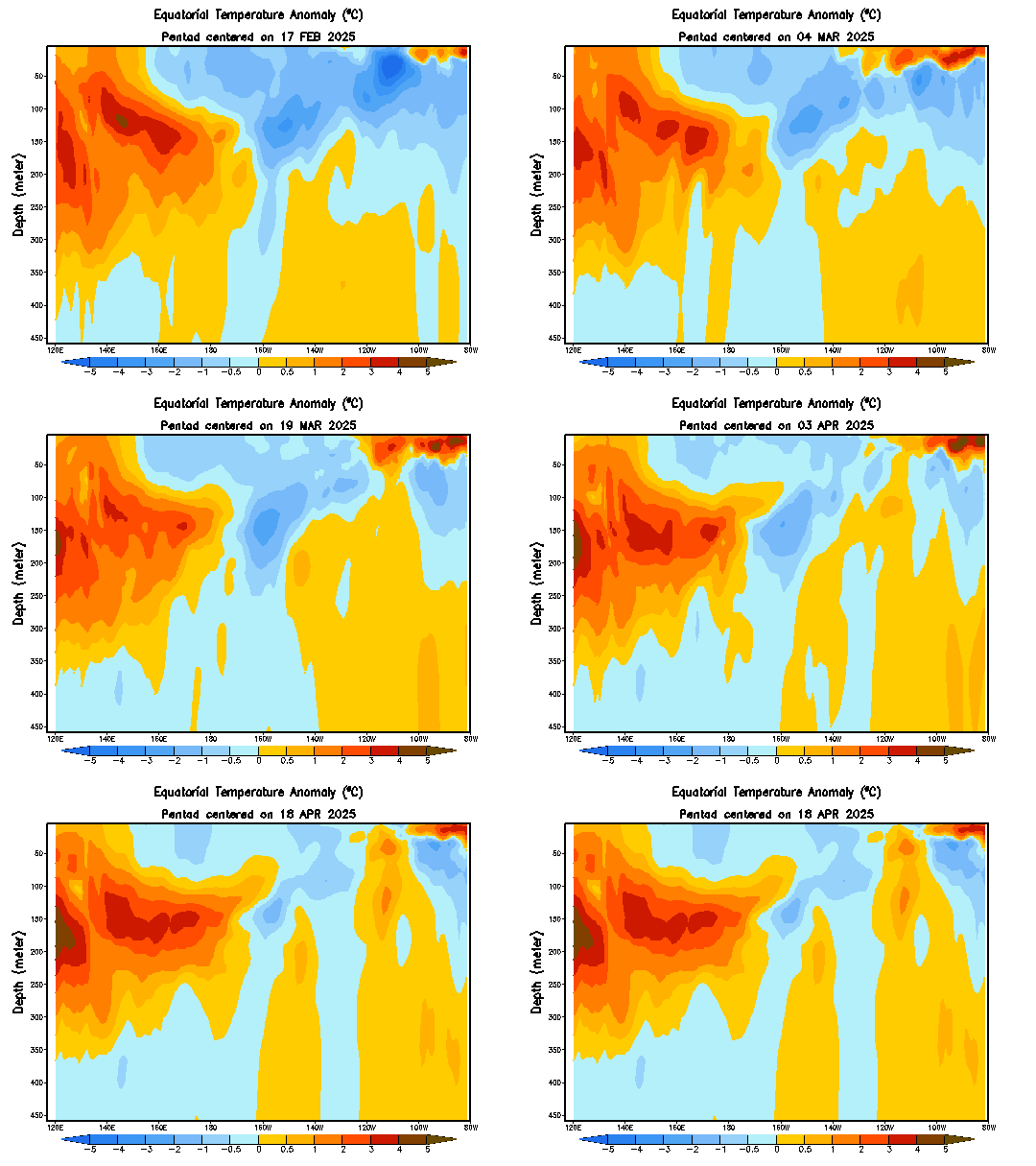
The big discussion in the weather world revolves around the situation unfolding in the Pacific. Earlier this year, a record-breaking Kelvin Wave brought about the prediction of a moderate or strong El Nino event for this winter, with calls for Super El Nino-like conditions also being heard (admittedly, from me, too). The Kelvin Wave did hit the surface and brought about significant warming to the eastern Pacific waters. However, as we progressed into summer, these warm water anomalies seemed to evaporate overnight, the culprit seen as the band of below-normal waters about 100 meters down from the surface in the animation above. As of now, we are counting on the mass of slightly above-normal temperature waters in the western part of the animation to push east and hit the surface to make another push at an El Nino. It remains to be seen how this will all play out. One possibility is that the warm waters can hit the surface and induce a weak El Nino event. Another possibility is that the cold waters eat away at the warm waters and eliminate the chances for an El Nino this winter.

My current thoughts on the matter are that we are likely to see a weak El Nino this winter. The dissipation of the strong Kelvin Wave has left us with nothing to support a moderate or strong El Nino, so the most likely scenario is a weak El Nino, if we are to see one at all. I'm uncertain as to how those cold water anomalies will react to when/if the warm waters push east; it'll be something to monitor closely this fall. When all is set and done, however, I'm supporting a weak El Nino. A weak El Nino set-up would resemble something like this, as the image below shows.

AccuWeather


To summarize:

I expect that we see a cooler than normal winter for many across the North US, primarily the Great Lakes, Upper Midwest, and Northeast. This comes as a result of the warm waters in the northeast Pacific, as well as the expectation for a weak El Nino. Temperatures should be warmer in the West US once again. I do think we see the drought in the Southwest US ease up at least a bit, but until we can nail down the presence (or lack thereof) of an El Nino, it's up in the air.
Precipitation looks to be on the above-average side around the Great Lakes again, thanks to lake effect snowfall, with the same outlook pegged for the Northeast. This comes from the warm waters off the East Coast likely interacting with cold air from Canada to produce the chance of precipitation. Conditions in the South Plains and Gulf Coast are likely to be slightly wetter than normal, with the opposite anomaly predicted for the North Plains. The Midwest and Ohio Valley ought to see around normal anomalies, as things look right now.

Bear in mind this is not my final forecast. It is merely an update with my personal thoughts, in advance of the 2014-2015 Official Winter Forecast to be issued in October.

Andrew