
"Second Consecutive Frigid Winter Expected..."
Hello everyone, and welcome to The Weather Centre's Official 2014-2015 Winter Forecast. This forecast will detail an examination of current atmospheric conditions, from the surface to the stratosphere, all around the world. Following the analysis, and discussion of analog years, the forecast will be discussed, which will include graphics and quick break-downs by region.
Please note that more in-depth regional outlooks are being issued from 12:00 PM Central Time to 1:40 PM Central Time today, October 11th. You can find all regional outlooks on the 'Winter Forecast Directory' tab at the top of this page.
Let’s jump right in and begin with an analysis of sea surface temperature anomalies across the world.
 |
| Unisys |
1. Below Normal SST Anomalies in the Sea of Japan
In the Sea of Japan, located to the west of Japan, we see a swath of below-normal to well below-normal sea surface temperature anomalies (henceforth abbreviated as SSTAs). These below-normal water temperatures were recently stirred up by the passage of a Typhoon Halong in early August, making quick work of what had previously been a rather prominent basin of well above-normal water temperature anomalies. If these below-normal anomalies persist into the winter, we would likely see two important consequences, which would have an impact on our winter.
First of all, the presence of negative SST anomalies tends to allow stormy weather and general low pressure to form over the region. A similar situation occurs with high pressure tendencies over warm SST anomalies. In our case, these negative SSTAs in the Sea of Japan would likely allow for predominantly stormy weather. This would, consequently, allow for the jet stream to be forced more to the south, allowing cold weather to hit Japan.
This leads into the second consequence, which focuses on a neat tool I've used for the past few years on this blog, with impressive accuracy. The tool is known as the Typhoon Rule, which you may have also seen referred to as something along the lines of an East Asian correlation or something similar. The gist of the Typhoon Rule, henceforth abbreviated as the TR, is that weather in Japan can be reciprocated in the United States 6-10 days after it happens in Japan. For example, a strong storm crossing Japan on a hypothetical date of January 12th would then lead to a chance for a storm system in the US 6-10 days later, around January 18th to 22nd.
If we do see the jet stream forced south due to these below-normal waters in the Sea of Japan, it may provide the opportunity for cold weather and storm systems to frequent the region. When you bring the Typhoon Rule into play after accounting for such storminess and cold in Japan, the risk of a cold and snowy winter suddenly becomes much higher. It remains to be seen if this sort of thing will work out, but there certainly is the risk for it to happen.
2. Well Above-Normal Water Temperatures in the Gulf of Alaska
This next SST feature is something I've been discussing here for the last few months. Since last winter, we've seen a swath of well above-normal SSTAs dominating the Gulf of Alaska and general Northeast Pacific region.
 |
| ESRL |
If we now compare the latest sea surface temperature anomaly image from UNISYS at the top of this post to the SSTA graphic on the right in the image directly above, it becomes clear that the warm pool really hasn't weakened all that much. That could spell big trouble for the United States; if this warm pool continues to persist into this winter, it could very well create another semi-permanent body of ridging/high pressure over the Gulf of Alaska this winter. For an example of what that would look like, just take a look at what happened with respect to temperature anomalies when that very thing happened last winter...
 |
| ESRL December-January-February temperature anomalies from this past winter |
3. Well-Above Normal SST Anomalies in the Bering Sea
This last factor could act as either a saving grace for the winter, from the eyes of a cold winter fan, but also from the eyes of a warm winter fan. Let me explain.
In my mind, there are two things that could happen, *IF* the Bering Sea becomes a major influence on the pattern this winter (which is a possibility, though you can thoroughly sense my uncertainty at all of this).
The first possibility I believe might happen is instead of persistent ridging forming in the Gulf of Alaska, it forms in the Bering Sea. This could happen, because like the Gulf of Alaska, the Bering also has a swath of well-above normal SST anomalies. If this does happen, I would expect that the Gulf of Alaska would suddenly become a very cold, stormy place, as the jet stream buckles south. What this would then do, is the stormy weather in the Gulf of Alaska (also abbreviated as GOA) would provoke high pressure to form in the West US.
This is where it gets dicey. The first possibility, one of the two things that could happen, is that the ridge of high pressure could then either stick around in the Rockies, where the pattern would then favor a cold winter for the Central & East US, or the ridge could shift east, and flood the Central US with warmth. The former option would favor a positive PNA-like pattern, while the latter option would support more of a negative PNA option. You can view both phases of the PNA to see what they look like in our Weather Glossary entry here.
It's a little early to be discussing which option might be more viable. As I make this forecast in mid-September, I'm seeing a very stormy period coming up for both the Bering Sea and Gulf of Alaska in the near future, which could complicate the situation even further.
To summarize, just keep an eye out to see what the Bering Sea does this cold season.
4. Above-Normal SST Anomalies Near Greenland
The last factor in this sea surface temperature anomaly chart we'll examine is the presence of warmer than normal waters near Greenland.
The presence of above-normal water temperatures near Greenland isn't just some random occurrence; it's a legitimate pattern in its own right. In the winter, warmer than normal SSTAs near Greenland and eastern Canada can allow for persistent ridging/high pressure to form over the land mass. You Northeastern weather junkies may know this phenomenon to be the negative phase of the North Atlantic Oscillation (NAO); the Weather Glossary definition for the NAO can be accessed here.
Considering we're likely heading into a weak El Nino (which we'll discuss next), and warm waters are indeed surrounding Greenland, high pressure/ridging over Greenland might be something to watch carefully for. We could even see some upper-latitude 'blocking' scenarios*.
*Blocking is defined as when strong ridges or upper level lows become entrenched in the atmosphere, literally "blocking" the atmospheric flow from continuing to move west-to-east. This has been known to enhance droughts in areas where blocking high pressure remains for days (or even weeks), as well as flooding in areas where blocking low pressure is found.
Sea Surface Temperature Anomaly Summarization
Even if you just skimmed over all of those words, you can probably get the gist that the ocean temperature patterns are supportive of a colder than normal winter right now. As was stated, though, watch for some surprises, especially with respect to the Bering Sea.
Up next, we'll branch off from the SST anomaly discussion, into a similar-yet-different talk about the El Nino-Southern Oscillation (ENSO) phenomenon.
 |
| CPC Refresh page if animation stops looping. |
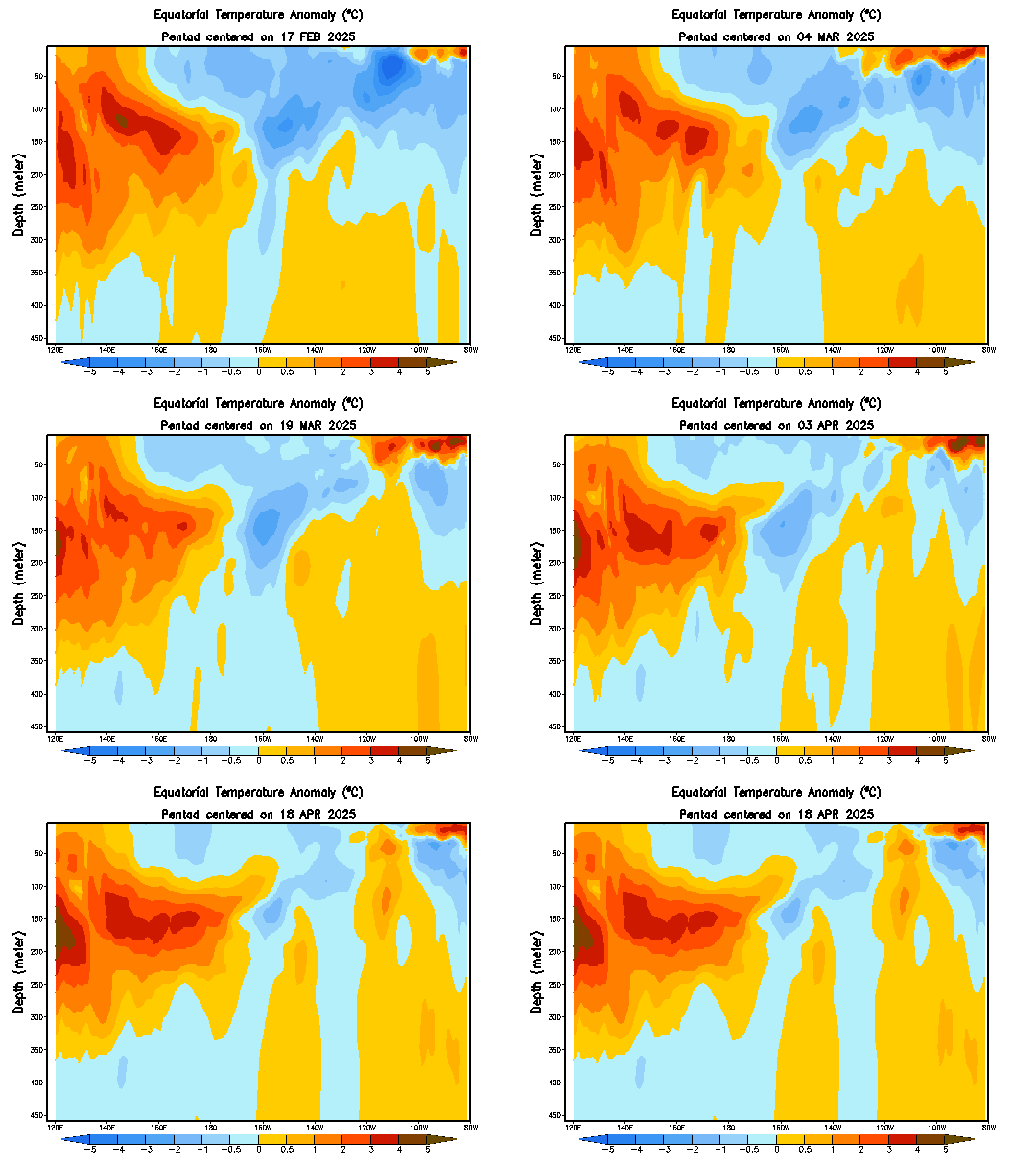
First and foremost, we saw a Kelvin Wave push through in the last few weeks, which resulted in the formation of above-normal water temperature anomalies a couple hundred meters below the surface. As time went on, the Kelvin Wave pushed east, as did the warm waters. In the last few weeks, we've begun to see these warm waters push up to the surface, a natural phenomenon for a Kelvin Wave. We saw a similar event happen this past spring, but we never got the El Nino to form.
Many people asked 'Why?'
The answer's more simple than you might expect.
 |
| BOM |
This past April, when the record-breaking Kelvin Wave traversed the Pacific, the SOI was definitely below that negative-8 threshold. In fact, we almost saw it reach negative-15. However, in the following first days of April, the SOI spiked back to neutral, then to positive for another few months. This resulted in Equatorial trade winds essentially shutting down the whole operation, making all that excitement go to waste.
Now, however, we have the Kelvin Wave-induced waters pushing to the surface at a time when the SOI has been negative since the first days of July. Put two and two together, and the ingredients are coming together for our highly-anticipated El Nino to show itself in the next several weeks.
 |
| IRI |
What we take away from this forecast plume is that the average of all of these models predicts a respectable weak El Nino to form this fall and continue into the winter, as that yellow line shows. This jives well with all other indications we've been receiving, and I see no reason to disagree with it at this time.
Let's quickly review what a typical weak to moderate El Nino, the sort of thing we're expecting this winter, brings to the United States in terms of precipitation and temperature anomalies.
 |
| ESRL |
 |
| ESRL |
Now, here's the thing about the lack of an anomaly like we see in the Plains above- it's rubbish. Trash. False. However you prefer to say it, there's no way every weak El Nino brings normal precipitation to the Plains every time. That's why I caution people when looking at composites like these, because they aren't set in stone... at all. It would be a poor decision on my end to base my forecast off of these composites, because 99.999% of the time, other factors in the atmosphere will make the winter different than these composites say. Somewhere along the line, yes, the Ohio Valley will probably get more dry winter seasons than wet ones in El Nino, but for those neutral-shaded areas (again, another paradoxical phrase), I wouldn't put much stock into it.
El Nino-Southern Oscillation (ENSO) Summarization
The theme this winter is expected to be a weak to possibly moderate El Nino, though if I had to make a decision this moment I'd go more for a weak El Nino as opposed to moderate. Regardless, this should add some more support for a chilly winter in parts of the Central and East US, while making prospects in the West even warmer.
Next up, we'll take a look at the state of the sun.
 |
| ISES |
From here, conditions only get quieter. The red forecast curve has us on the downward trend in coming years, meaning we have now passed the peak of this solar cycle. In a decade or two, this may have profound effects on the weather as we know it, but let's stick to the next several months for now.
The sun influences our weather more than most people realize. In a general nutshell, when the sun is in/around its peak of the solar cycle, sunspot numbers are enhanced, and winters tend to feature warmer weather at the mid-latitudes. This comes as a result of ozone being depleted en masse, as the active sun sends harmful rays into the stratosphere, dissolving that ozone, and cooling the atmosphere. This results in fewer opportunities for upper-latitude blocking, which leads to fewer opportunities for cold weather, and so forth. In a winter with a low number of sunspots, ozone is able to build up more freely, which warms the stratosphere. This warmth prohibits the polar vortex from strengthening too much (since it is also located in the stratosphere), which then leads to upper latitude blocking, and then additional opportunities for colder than normal winters.
 |
| Solen |
Solar Summary
The sun is expected to remain anomalously weak as we head into this winter, setting the stage for another exciting time in the stratosphere. The door is open for events such as sudden stratospheric warming (SSW) events, which could lead to outbreaks of cold air this winter.
Something I want to briefly touch on before we proceed is the Quasi-Biennial Oscillation (QBO).
 |
| FU-Berlin |
The Quasi-Biennial Oscillation (QBO) is what makes these positive and negative anomalies flip on a regular basis. In the last few weeks, we've just made the transition from a positive QBO to a negative QBO, as the elimination of positive zonal wind anomalies in the bottom panel shows. As we enter the upcoming winter, a negative QBO is expected to be in place. In essence, this will likely strengthen the risk for another cold winter this year.
Now, it's time for our final portion of the analysis section for the Official 2014-2015 Winter Forecast: the Analogs.
I created this year's analogs out of a four chosen long range predictors, before using personal judgement and individual examinations to narrow it down to my four analog years.
 |
| ESRL |
In this 500mb height anomaly image, we see quite a few interesting features. First and foremost, we see the Arctic Circle inundated with blocking high pressure, with the polar vortex virtually nonexistent in the upper latitudes. Three areas of significant ridging exist, as shown by the yellows and reds- one is located north of the Bering Sea, another juxtaposed over Greenland, and a third displaced in the middle of Eurasia. This leaves us with a very important question... Where did the polar vortex go?
It looks like the analogs are seeing the polar vortex positioned right over the Northeastern United States.
A very strong area of troughing is visible over the Northeast into the Canadian Maritimes, and a glance around the world shows no other body of troughing that is comparable to the one in North America. With that in mind, I do believe the analog years are pushing the polar vortex into the Eastern US.
This is something that can be predicted, as the analogs show sustained blocking high pressure over Greenland, as well as ridging over the Western US. These two factors, combined with overwhelming blocking in the entire Arctic Circle and general upper latitudes, easily permit the polar vortex and associated bone-chilling air to push into North America, specifically the eastern section.
 |
| ESRL |
The Western US averaged above normal for these four years, with the West Coast and Rockies experiencing temperature anomalies anywhere from +1.0 degrees to +3.0 degrees or so above normal. This doesn't exactly spell good news for those hoping for drought relief in the West, as the ridging and warm temperatures shown in these two images typically result in dry conditions as well.
 |
| ESRL |
 |
| CPC |
Gazing over the image above, specifically around the most recent records of temperatures, we find ourselves on the above-normal side, with that red line bursting up into above-normal territory more than once in the last few weeks. This year's warmth at the 70mb level looks to be a bit more prevalent than that of last year, as you can see just to the left of the center of this image.
Why is this important to the coming winter? Above-normal temperatures in the stratosphere allow for a higher threat for persistent high pressure to form over the Arctic Circle, and general upper-latitude area. The polar vortex, a strong low pressure system of cold air located across the troposphere and stratosphere, can be strengthened during times when the stratosphere is colder than normal, and weakened when warmth prevails.
When this warmth prevails, strong bodies of high pressure can punch north from the lower latitudes into the Arctic, disrupting the polar vortex. When this happens, fragments of the vortex can break off and be sent to the lower latitudes (as was seen last winter), or the whole vortex can be shunted down south. If the high pressure sticks around in the Arctic for long periods of time, it can be referred to as "blocking" high pressure, for the way it "blocks" the pattern from flowing east to west around the globe, since the high pressure remains stagnant and backs everything up.
If the stratosphere is to remain warmer than normal this winter, the polar vortex may fragment, leading to increased risks for cold air outbreaks in North America.
To sum everything up, here are the main points I'm looking at.
• Warmer than normal stratosphere may create blocking high pressure
• Positive PNA pattern expected this winter
• Negative NAO pattern possible, duration unknown.
After discussing everything above, here is the Official 2014-2015 Winter Forecast.
 |
| The Weather Centre |
In the Western US, warmer than normal temperatures are expected to prevail, in light of ridging shown in my analog years above, and the current positive-PDO state. These warmer than normal anomalies should extend into the central Rockies, before variable/average temperatures are anticipated.
 |
| The Weather Centre |
In the West, another dry winter looks to be in store. The dry anomalies should focus in on the Pacific Northwest, as that region is typically drier than normal in an El Nino. However, dry anomalies may work their way south into the Southwest area, but I'm anticipating average to slightly below average anomalies there. The Plains are shown as average now, but may require a boost to slightly above average in the future.
 |
| The Weather Centre |
Without further ado, here is the overall graphic.
 |
| The Weather Centre |
Thanks for viewing!
For regional, international, and personalized winter forecasts: CLICK HERE
Andrew


