Showing posts with label East Pacific Oscillation (EPO). Show all posts

Tuesday, January 5, 2016

Brief Pattern Change Expected Next Week

A change in the current weather pattern, albeit a brief one, is expected next week.

PSU
Image Valid: January 12
Ensemble forecasts see strong ridging building over Alaska and extreme northwest Canada, extending from northern Siberia all the way across the Arctic Circle to the waters immediately south of Greenland. Consequentially, this will force the tropospheric polar vortex to lower latitudes, and it just so happens that ensemble guidance sees a piece of this vortex will dip south into Canada, and will exert its influence on the United States.
It's important to note that the tropospheric polar vortex will not enter the United States, it will stay well north of the Canada/US border. Cooler air will still result, but extreme cold should not be expected right now.

PSU
Image valid: January 15
By January 15th, the pattern is progressive enough so that the piece of the tropospheric polar vortex shifts east into eastern Canada. We also see strong ridging dominating the Arctic Circle, which will drop the Arctic Oscillation (AO) index well into negative territory, as we'll see a little later on in this post. Note the strong trough modeled over the Gulf of Alaska- this will maintain a positive phase of the East Pacific Oscillation (EPO). While I won't discuss the EPO in this post, that trough in the Gulf of Alaska is what will return our pattern to a more seasonal, and possibly warmer than normal pattern after this brief change to chillier temperatures.


Above 3 images from CPC
Just a brief look at the teleconnection forecasts, we see the Arctic Oscillation (AO) and North Atlantic Oscillation (NAO) both expected to drop into negative territory. This is a sign for cooler than normal weather, and as we saw earlier in this post, ensemble guidance believes a brief shot of colder weather will hit the Central and East US. The Pacific-North American (PNA) index is expected to stay positive, possibly heading more towards  neutral territory in the medium-long range, but generally should remain positive. This is likely a result of that trough in the Gulf of Alaska. That trough will keep the pattern progressive, which means the ridge that forms over the West US as a result (the positive PNA indicator) will likely drift east and spread warmer weather east.

To Summarize:

- A brief flip to colder weather is expected next week, mainly between a January 10-15 period.
- Warmer weather is expected to return after January 15th.

Andrew

Sunday, December 20, 2015

Early Signals For Pattern Change in Early January

There are emerging signals for a change to a colder and snowier pattern in the early days of January 2016.

PSU
The image above shows the GFS Ensemble mean 500mb height anomaly forecast for hour 384- the infamous fantasy land, end of the run panel. The ensembles are expecting ridging to build up along the west coast of North America, with troughing taking over in the Bering Sea and Arctic Circle. This kind of pattern would likely promote an overall-cooler set-up than the one we're currently in, which will feature well above normal temperatures on Christmas Day.

You all know I wouldn't post a 384-hour graphic without good reason, so let's dive in.

CPC
The ensemble forecasts out of the Climate Prediction Center for the Pacific North American (PNA) index show a dip to negative values as we head to Christmas, but then rising to neutral, and even positive values to kick off 2016. The majority of members are in positive territory by the start of the new year. The relative consensus of most ensemble members on a neutral or positive value of the PNA is encouraging for winter weather fans. Positive PNA values typically result in colder and snowier weather for the Central and East US, while negative PNA values result in warmer weather.
Some of you may ask why it's been so warm even though the PNA was positive in December- that can be attributed to the El Nino, producing enhanced convection in a part of the Equatorial Pacific conducive for warm weather here in the U.S., however that's a topic for another post.

ESRL
A grand overview of four key teleconnections reveals this improving pattern (improving, at least in the eyes of winter weather fans). We see a continued positive EPO through the forecast timeframe- if you're more knowledgeable, you'll recall that the positive phase of the East Pacific Oscillation (EPO) encourages colder weather in the eastern 2/3rds of the country, while the negative phase encourages warmth. The WPO (West Pacific Oscillation) closely follows those guidelines as well.
As noted earlier, we see the forecasted PNA rising to at least neutral values in the long range near the start of 2016.

If all of these forecasted indices and teleconnections verify on an as-is basis (which, I may add, is rather unlikely), we could expect a cooler pattern in the Central and East US. This would be mitigated by the positive phases of the Arctic Oscillation (shown in the first image by negative height anomalies across the Arctic Circle) and North Atlantic Oscillation (shown in the first image by weak troughing over Greenland), both of which tend to discourage persistence of colder weather.

To summarize:

- There are indications that a pattern change may be on the way for the start of 2016.
- Model guidance will change drastically, and this is nowhere near set in stone. However, if this does verify to a certain degree, a cooler pattern may be on the horizon.

Andrew

Friday, February 27, 2015

Long Range Ensembles Predict Incoming Spring-Like Weather

Long range ensembles are indicating a much warmer weather pattern is on the way for much of the country that has been held hostage by brutal cold in the last month.

PSU
Click to enlarge
The above image shows 500mb geopotential height anomalies from the GFS ensembles, projected over the Northern Hemisphere and valid for March 1st. In this graphic, we see a massive ridge of high pressure, the same one which has allowed for such a cold and snowy February, meandering westward over the north-central Pacific, as opposed to the northeast Pacific and Gulf of Alaska. This comes as a strong trough drops into the Southwest and Baja California. In response, with the strong upper level low previously positioned over Greenland, now over Europe, a ridge is able to form over the Central and East US. It looks like this ridge will be suppressed a bit, but warmer weather is on the way for those in the Plains, Midwest, Ohio Valley, and Northeast, among other areas.

PSU
By March 7th, ensembles are indicating the ridge remains in the north-central Pacific, but an upper level low has now developed in the Gulf of Alaska. Unfortunately, this then results in a ridge forming over the Western US, as the graphic above shows. Consequentially, the semi-permanent Arctic long wave trough (better than using 'polar vortex', apparently) is being pushed back into North America, setting up another period of cold weather for the Central and East US. This would likely last for a handful of days, right between February 5-10 or so.

But... finally... finally!... relief comes.

PSU
In the long-long range, to March 11th, ensembles see our ridge forcing itself north in the north Pacific into the Aleutian Islands, along the jet stream, where the "polar vortex" is stationed just off to the north. The net result for us is another trough setting up over the western section of North America. You weather enthusiasts know this as a negative Pacific-North American (PNA) pattern, with a trough in the west and warmth in the East.

This looks to be our new pattern, going strictly by these ensembles. Stormy weather in the West with predominantly warm weather out east.

To summarize:

- A brief warm-up is expected in the final days of February and early days of March.
- Another cold blast can be expected around March 7th.
- The pattern may then shift to a warmer set-up for the middle half of March.

Andrew 

Thursday, February 19, 2015

Long Range Outlook (Made February 19, 2015)

This is the updated long range outlook, made on February 19th, and valid for late February into the first half of March.

Tropical Tidbits
Click to enlarge
We're currently seeing a portion of the semi-permanent Arctic low pressure vortex intruding into the United States, with anomalously low 500mb geopotential height values appearing in the colored shadings and analysis in the graphic above. This anomaly has been forced by a strong ridge pushing into Alaska from the northeast Pacific and west coast of North America. Over the next few days, cold air intrusions should continue as this ridge flexes its muscles and persuades additional Arctic air masses to collapse into the lower latitudes.

ESRL
I want to now go over the teleconnections over the next two weeks, which can help us diagnose the pattern heading into the 14-31 day period.

Top left: PNA Forecast
Top right: NAO Forecast
Bottom left: WPO Forecast
Bottom right: EPO Forecast

A quick refresher on the PNA, NAO, WPO and EPO...
The Pacific North American index involves what the atmosphere does in the northeast Pacific and the western coast of North America. When we see a stormy pattern in place over these regions, we call such a pattern a negative PNA, due to the below normal height anomalies in this region. In a similar sense, when high pressure dominates that same region, we call that a positive PNA. A negative PNA will bend the jet stream to give the storms to the Plains and the Deep South regions, frequently initiating high pressure system formations over the Central US. A Positive PNA will bring about an opposite response to high pressure (HP) over the West, and will have the stormy pattern evolve over the East US.

The North Atlantic Oscillation involves the presence of a high pressure system over Greenland (negative NAO) or the presence of a low pressure system over Greenland (positive NAO). In the negative NAO, the jet stream will buckle into the Northeast to allow storms and cold to thrive in that region. The positive NAO denies this region any of these benefits.

The WPO (West Pacific Oscillation) and EPO (East Pacific Oscillation) are very closely related. In the negative phase of the WPO, a strong ridge exists over the Bering Sea, which can allow for sustained cold weather in the Central and Eastern United States. The negative phase of the EPO gives similar results, though the ridge is positioned in the Gulf of Alaska instead. The positive phase of both the EPO and WPO see warm weather prevail in much of the US, as stormy weather replaces the ridges in each respective region.

The positive PNA and negative EPO have worked in tandem to indicate this strong ridge blossoming into the Gulf of Alaska and general northeast Pacific. In the upcoming couple of weeks, model guidance is indicating we see the ridge shift further offshore to the west, as the PNA dip from positive to negative shows. Over time, ensemble guidance is telling us that this ridge could keep shifting west, resulting in the EPO actually moving positive for the first time in a while. The positive EPO signal, however, is weak, and will have to be watched for a 'false positive', both literally and metaphorically. If this forecast does verify, we can expect a warm-up in the early days of March.

Tropical Tidbits
Ensembles indicate we will see a ridge of high pressure pushing into Japan on the morning of February 21, as the graphic above shows. Using the Typhoon Rule, which states weather phenomena occurring in Japan is reciprocated in the United States 6-10 days later, we can anticipate a warm-up for millions that have undergone a brutal February in the final days of the month, likely into early March. From there, confidence decreases, but a return to an average or cooler than normal pattern may be expected.

You'll notice I haven't used tropical forcing in this post; that's because the ridge in the West is just so overpowering that the Madden Julian Oscillation can't do much of anything.

To summarize:

- A cold pattern is expected to round out February.
- A warm-up is expected for the last days of the month into early March.
- The first half of March should be characterized by a generally average to slightly below-average temperature pattern. There are hints of some stormy weather in early March.

Andrew

Thursday, February 12, 2015

Long Range Outlook (Made February 12, 2015)

This is the Long Range Outlook, valid for the middle and end of February into the start of March.

PSU
Ensemble guidance close to 9 days out from today shows a pattern highly conducive to cold weather across North America. We see a strong ridge positioned across the west coast of North America, pushing into Alaska. The alignment of this ridge closer into the Gulf of Alaska as opposed to along the shoreline indicates a negative East Pacific Oscillation (EPO) pattern. This sort of pattern allows for sustained northwest flow (winds out of the northwest) in the Central US, and this is well shown by the strong upper level low buckling south into the Great Lakes. Short range projections show very cold temperatures slamming much of the nation, hitting the northern Ohio Valley and Northeast very hard in particular. This cold pattern looks to be enhanced by some ridging, albeit suppressed, south of Greenland. I am concerned that the ridge not being positioned closer to Greenland could make this cold weather more progressive and not as long-lasting as current ensembles are making it out to be, though those details can be sorted out further down the road. For now, the opening days of this 7-31 day forecast period are looking very cold.

PSU
By Hour 348, which is about 14 days out from today, we see a shifting of the members mentioned above to the west. Our negative EPO ridge has now been shunted west, and now occupies the Bering Sea into waters to the southwest. The strong upper level low still remains on our side of the hemisphere, but the core of this low has been retracted into the North Atlantic, with a leg of negative height anomalies stretching out to the Rockies. As a result, the general idea is that more progressive flow can be expected as we round out February, which should be able to moderate any cold blasts near the end of the month. We also see ridging coming up offshore of the East Coast, which could put an end to what looks to be an incredibly cold and snowy February for millions in the East.

Albany
We now turn to tropical forcing to help us identify the pattern for the beginning days of March. Looking at the bottom panel, we see a significant swath of enhanced tropical convection blossoming just south and east of the subcontinent of India, depicted by the deep blue shadings. If we match the positioning of these anomalies to the eight phases of the Madden Julian Oscillation, we can expect the emergence of a Phase 3 or Phase 4 event, as the composite chart below shows.

BOM
Generally, Phase 3 events support cooler than normal temperatures in the United States, while Phase 4 composites indicate warmth prevails across the country. Purely due to how February looks to shape up, I would favor a chillier outlook to kick off March. This method of persistence forecasting tends to work well, particularly when the pattern seems to 'lock in' to a certain temperature alignment; in this case, a cold Central and East US, with warmth in the West.

CPC
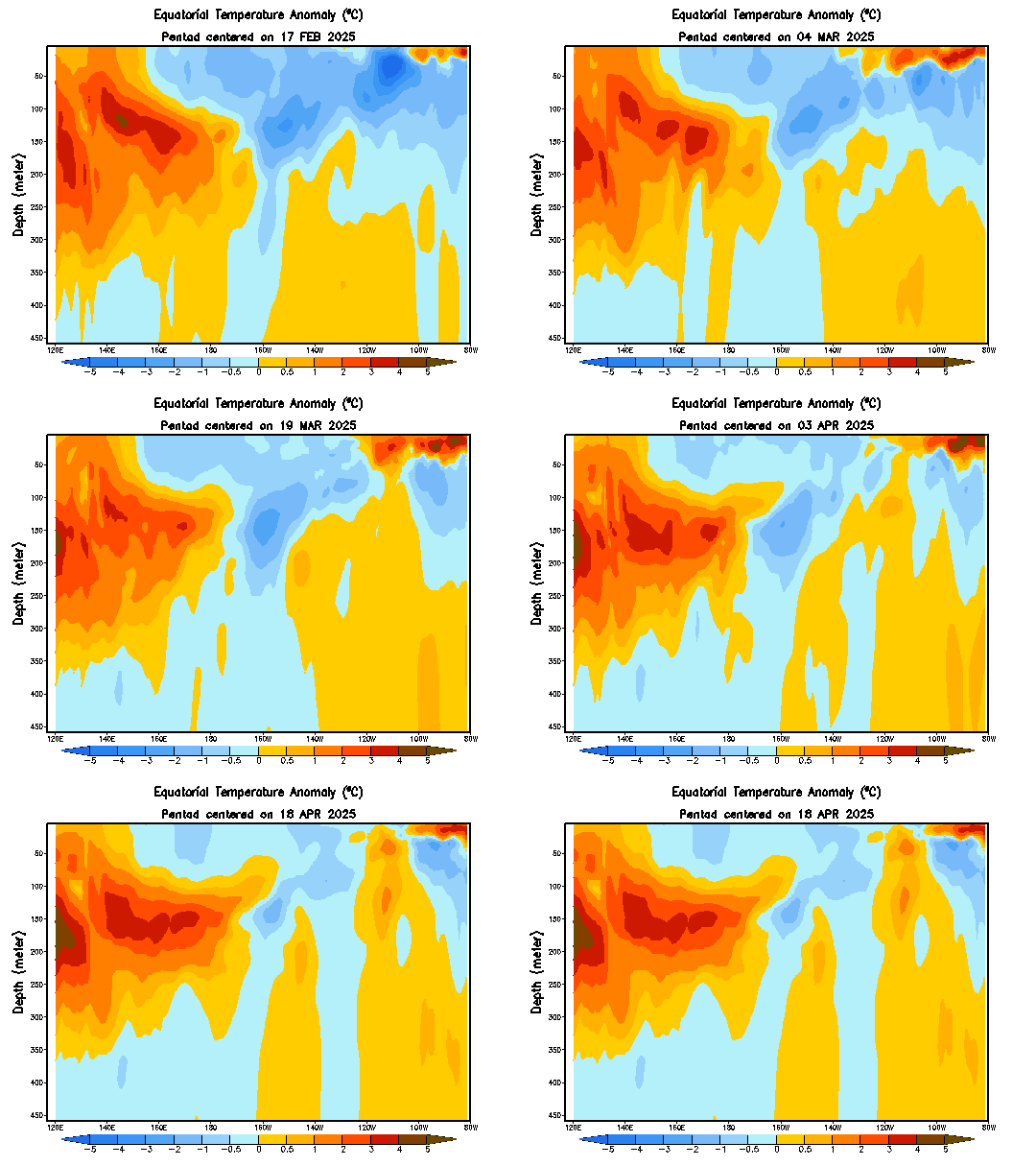
Looking even further out, just for kicks, let's go over sea surface temperature anomalies, under the surface. Anomalies show the 'warm part', the upwelling phase of a Kelvin wave moving eastward at a depth of about 100 to 200 meters. We're currently seeing the 'cold part' of that Kelvin wave, the downwelling phase, hitting the surface from about the 100 west longitude line on eastward. The warmth from the upwelling is already at the surface in the Central Pacific, and this could be setting up a more El Nino-like pattern. I personally find this to be plausible, as El Nino winters are notorious for a slow start and furious end, as we're seeing in real time right now in the East US.
In springs with an El Nino, temperatures in the North US will generally be warmer than normal, while the opposite scenario plays out in the South, with colder than normal temperatures. It remains to be seen if this will play out in the March-April-May period, but it'll be something to watch.

To summarize:

- A very cold pattern will unfold over the next 7-14 days.
- There are hints of a warmer pattern coming around for the period beyond 14 days, but this needs to be watched for potential failure.
- It is expected that the East will remain overall below normal throughout the entire period in temperatures. A similar story, though not as cold, may be expected in the Central US.
- Snowfall should favor the East US in this entire pattern, though a shift to a more inland track could occur in late February if model guidance ends up being correct.

Andrew

Tuesday, December 16, 2014

Atmospheric Trifecta Preparing to Deliver Cold, Snowy January

A trio of atmospheric signals are gearing up for what could be a rather cold, snowy January.

Research I completed last night showed significant (10"+) snowstorms in the Midwest are most favored under the negative phase of the Arctic Oscillation, the negative phase of the East Pacific Oscillation, the negative phase of the North Atlantic Oscillation, and the positive phase of the Pacific-North American index. We look to have at least three of these factors locking down the atmosphere to round out December and kick off 2015.

Tropical Tidbits
The image above shows the GFS ensembles' forecasted 500mb geopotential height anomalies over the Northern Hemisphere, valid on the evening of December 26th. On this graphic, we see a prevailing negative EPO, as highlighted in this graphic with ridging over the Gulf of Alaska. A negative NAO has also emerged just west of Greenland, combining with ridging in Eurasia to provoke a negative AO regime. I'm watching for a positive PNA signal, but as a ridge is passing over the region, I'm content on acknowledging a trifecta for now.

It doesn't end there, however...

Tropical Tidbits
By December 30th, we find more than a few big developments have taken place. We see our negative EPO ridge has blossomed into a massive swath of high pressure, now extending along the West Coast into Alaska... and then some. Ridging over Greenland still exists, paving the way for a continued negative NAO and negative AO tandem. As a result, we continue to observe below-normal anomalies in the East US, signaling a very cold period to end December and start January.

My thinking is we'll see those below-normal height anomalies slowly progress west, as a west-based negative NAO (where the ridge is displaced to the west of Greenland) typically favors cold weather more into the Central US. This would be amplified/supported by the strong -EPO ridge, slowly evolving into a +PNA signal, it appears.

Now, onto the snow...

Tropical Tidbits
The image above shows the GFS ensembles projection on December 28th, showing jet stream wind speed values. There are a few things to note here.
First off, check out the extended Pacific jet stream. We're seeing that occur in the very near future, and it's no coincidence that this extended jet stream into North America is happening at the same time some storm threats are arising. The extended jet allows for cyclogenesis in the Northern Pacific, where energy may be shunted east into the United States, leading to those winter storm chances.
Second, we see a notable subtropical jet stream (STJ), as depicted by the green colors extending from the northeast Pacific into Mexico and the South US. With a negative NAO regime in place, as well as an enhanced subtropical jet stream, it's possible the East Coast could get rocking and rolling with these storm chances.

As for the Central US, I alluded to the below normal height anomalies pushing east. As far as snowfall impacts, clipper systems look to make their return, as the strong ridge pushing into Alaska produces a sustained northwest flow pattern (where the winds are out of the northwest). This could lead to not only episodes of snow in the North US, but also lake effect snow episodes, as all Great Lakes are currently well below last year's ice levels at this same time.

To summarize:

- The atmosphere is preparing to shift from a generally mild December pattern to a rather harsh January pattern.
- Sustained cold weather is likely for most of the nation east of the Rockies.
- Enhanced chances of snowstorms will be seen both along the East Coast, into the Central US (depending on individual storm tracks, of course).
- Buckle up, things are about to get fun.

Andrew

Saturday, December 13, 2014

December 19-21 Potential Winter Storm

Model guidance is supporting the risk of a winter storm in the December 19-21 timeframe.
I'm trying to decide how to start off this post, since simply going through model guidance won't work. I'll begin by explaining each graphic, doing a compare/contrast as we do so.

Tropical Tidbits
The latest GFS model has a trough pushing into the Midwest on December 20th, as the blue colors and depression of contour lines shows. This trough is beginning to close off after becoming negatively tilted, and is pushing northward as a result. The surface low takes a track through the Ohio Valley on this run, dropping appreciable snows from east Kansas into southern Michigan. North Missouri sees snow over 6" from this system.

In this overview of the pattern, we can diagnose a few items arguing for this more inland track, as future guidance I'll show you will depict an East US track. First of all, we have another strong trough dropping into the West US, trying to work its way southward. This will try and force a ridge to develop in the central and eastern Rocky Mountains, as we can already see above. However, as we see a deep upper level low over Greenland, this ridge won't be able to exert too much influence (that ULL over Greenland defines the positive phase of the North Atlantic Oscillation/NAO, notorious for keeping the jet stream very 'non-wavy')
What does make a ridge form, however, is the troughing in the Bering Sea into the Gulf of Alaska, a textbook positive East Pacific Oscillation (EPO) pattern, which will act to limit cold air reserves in Canada, but also try to direct storm systems northward. The latter influence is seen well in that ridge centered over New York, just east of the storm system in question. That same northward influence could happen along the East Coast, but for now, the GFS favors this solution.

Tropical Tidbits
Here's the ECMWF 500mb geopotential height anomaly forecast, valid at the same time as the GFS graphic. We see more than a couple significant differences here.

First and foremost, the storm system in question seems to be developing a second piece of energy, signified by that second dip in the contour lines along the Gulf Coast. Looking at the forecast following this timeframe. it looks as if that second piece of energy will act to pull the main trough east, and develop it into an East Coast system. This is far different from the GFS, which maintains a single trough.
Additionally, we see the entrance time of the second trough into Western North America has been slowed by about a day. This allows the ridge in the central and eastern Rockies to flourish well into Canada, where the ridge up there is also quite a bit stronger than its GFS counterpart. Consequentially, the storm system is suppressed to the south in the ECMWF forecast. Also, note the lack of a ridge to the east of the storm system in the ECMWF image, compared to the GFS. This, combined with the extra piece of energy along the Gulf Coast, appears to favor an East Coast solution. The solution results in this pattern, valid 24 hours after the image above:

Tropical Tidbits
Purely for comparison, here's the GFS snowfall forecast I mentioned earlier, expressing the solution in opposition to the ECMWF:

Instant Weather Maps
I've been looking back and forth between the ECMWF and GFS images I've shown above, trying to figure out which one I think is the most valid, and I can't decide.

On one hand, the ECMWF projection appears to be obeying the positive EPO signal, as exhibited by troughing along the west coast and a strong ridge in central Canada.

On the other hand, the GFS is doing well with the emergence of a ridge just east of the trough, possibly as a result of the negative PNA orientation out west, as the aforementioned second storm system drops into the West.

It will ultimately depend on the timing of when the trough drops into the West, just how strongly the atmosphere responds to the +EPO signal, and (of course) if that secondary piece of energy forms along the Gulf Coast. It's worth noting none of the model guidance is having any consistency with the ridge in Canada, purely by looking at run-by-run comparisons. Additionally, today's 12z ECMWF run (examined above) is the first one to have that secondary piece of energy develop to the south of the storm, something that does not bode well for any consistency that either the GFS or ECMWF may have built up. I'll pass on giving my opinion right now, because this is a truly grotesque set-up.

To summarize:

- A winter storm is possible for the Central or East US in the December 19-21 timeframe.
- Model guidance is expressing little to no consistency on a defined track for this storm.
- Cold air availability will eventually become a concern.
- Anomalously low confidence exists.

Andrew

Thursday, December 11, 2014

Christmas Potentially Significant Winter Storm

I'm now watching the risk of a strong winter storm rise as we move towards Christmas.

Tropical Tidbits
The image above shows 500mb geopotential height values (colored shadings), with mean sea level pressure (MSLP) values superimposed. In this graphic, valid on December 16th, we see a pair of very strong storm systems, one on each side of Japan. The prognosis is that a strong system will push into the Sea of Japan (located west of the country), while a second storm system will develop in the southern part of the country and move northeast-ward, skirting the eastern fringe of Japan as it does so. It is this second storm that we need to keep a close eye on, and is the one we will be discussing here today.

Using the Typhoon Rule, which states that weather phenomena occurring in East Asia is recipricated in the US about 6-10 days later, we can extrapolate this December 16th date out and predict a storm in the United States in a December 22-26th period... right in the Christmas rush.

But we can expand on this quite a bit more. The storm will be shooting north along the eastern coast of Japan. This does have an impact on the expected storm in the US. As you might expect, it raises the chance of this consequential storm also moving northeast-ward rapidly, and from there, we come out with two prevalent/possible storm tracks:

- A Panhandle Hook storm, where the system shoots north from the Southern Plains. These storms are climatologically favored to bring heavy snow to cities in the east-central Plains and Lower Great Lakes. This scenario is a possibility, as that strong storm in the Sea of Japan would likely correlate to a strong North Plains cyclone. This would keep that body of low pressure east of Japan in an area close-by, as the storms would eventually phase (not to mention low pressure areas are attracted to other low pressure areas).

- An East Coast storm. Because this body of low pressure is forecasted to merely skirt the eastern side of Japan, this could be a plausible scenario. We won't know if either of these are correct until we have more model runs to access.

The graphic above only shows the GFS model view... let's head on over to the European model projection.

Tropical Tidbits
Wow! Can you see the change?

This graphic, showing the same parameters as the GFS image, and for the same timeframe, portrays that strong storm in the Sea of Japan, but now the second storm skirting eastern Japan is more inland. It hasn't shifted much, but it has shifted nonetheless.

What does this mean? It means it's time for East Coasters to throw in the towel.

Not really, but a more inland storm does favor an inland track when the storm comes around in the US. The interesting thing is, this more inland track is an idea. Here's why.

Recall that, whether you learned it or just know it through logic, low pressure areas will try to move towards areas with the least resistance, in this case the least high pressure. My theory here is that the storm in the Sea of Japan, the stronger of the two (shown on the GFS as 993mb, 980mb on the ECMWF), is trying to pull the storm skirting east Japan towards itself. Down the road, model guidance shows the second storm absorbing the stronger Sea of Japan storm, rather than vice versa, and that's also a possibility.
My point here is, there is the possibility of a phased storm.

For those who aren't as knowledgeable with weather lingo, a 'phased storm' is a storm system which is made up of previously-two or more pieces of energy. Typically, phased storms end up stronger than either of the first two pieces of energy were. I'm not holding my breath on this Christmas storm phasing, but it probably isn't a bad idea to keep it in the back of your mind.

Regardless of if this storm phases, remember that the storm on the east coast of Japan is projected to be below 1000 millibars, so it's likely to be a nice little storm in itself.

Tropical Tidbits
We've now confirmed that not only are looking at a storm in the Christmas time period, but model guidance has amped up that threat since yesterday. Now, we have to diagnose the weather pattern here at home in that December 22nd - 26th timeframe, to see if we can pull any hints out.

I've posted the image above from the GFS ensembles, showing 500mb geopotential heights on Christmas morning. Warm colors depict ridging/high pressure, usually indicative of warm and quiet weather. Similarly, blues indicate troughing/low pressure, accompanied by colder and stormier weather. We have more than a few things to talk about with the above graphic.

First and foremost, we're looking at the Pacific driving our pattern to round out December. Tropical activity in the Equatorial Pacific will be dying off in the next few days (more knowledgeable weather folks know this as the MJO weakening), which will shift the weather pattern 'responsibilities' to the North Pacific.

We look to have a positive Pacific-North American (PNA) index pattern in place for this event. We can observe this positive PNA as a ridge forming in the West US, which allows the jet stream to buckle in the Central US. Such a pattern is climatologically favorable for a Central US storm track. In addition, a positive East Pacific Oscillation (EPO) signal will begin showing up, as ridging overtakes Canada. This will be in part due to that positive PNA, but the further east you go, the more the EPO influence takes over. A positive EPO doesn't affect the storm track so much as it does temperatures (above normal in the North US). When we factor into account slight ridging along the Eastern Seaboard, we start to see that signal for a storm system in the Central US, favoring development in the Central US.
I'm a bit skeptical, however, Many Northeast weather buffs may know that winter storms are favored in the East when the North Atlantic Oscillation (NAO) changes phases from positive to negative, or vice versa. Guess what the forecast for the NAO is around this storm's timeframe:

ESRL
We've got a dilemma on our hands, with some variables favoring a Central US storm, and others favoring an East US storm. So is the world of forecasting...

To summarize:

- A winter storm appears to be in the cards for December 22-26th, likely impacting Christmas travel plans.
- A second storm system may need to be watched for the Northern Plains.
- The primary threat here may become a storm favorable for heavy snow, either in the Central/East US (ideally the Ohio Valley/Midwest) or along the Eastern Seaboard.
- Rather high confidence in the threat of a storm in this timeframe, but low confidence in who will be most affected.

Andrew

Saturday, December 6, 2014

December 31 - January 5 Potential East Coast Winter Storm

I'm watching for the risk of a storm system, possibly associated with wintry weather given the pattern, along the East Coast on December 31 - January 5.

ESRL
Though we can't see out to January 5th, we can diagnose the weather pattern leading up to this timeframe.

Top left: PNA Forecast
Top right: NAO Forecast
Bottom left: WPO Forecast
Bottom right: EPO Forecast

A quick refresher on the PNA and NAO...

The Pacific North American index involves what the atmosphere does in the northeast Pacific and the western coast of North America. When we see a stormy pattern in place over these regions, we call such a pattern a negative PNA, due to the below normal height anomalies in this region. In a similar sense, when high pressure dominates that same region, we call that a positive PNA. A negative PNA will bend the jet stream to give the storms to the Plains and the Deep South regions, frequently initiating high pressure system formations over the Central US. A Positive PNA will bring about an opposite response to high pressure (HP) over the West, and will have the stormy pattern evolve over the East US.

The North Atlantic Oscillation involves the presence of a high pressure system over Greenland (negative NAO) or the presence of a low pressure system over Greenland (positive NAO). In the negative NAO, the jet stream will buckle into the Northeast to allow storms and cold to thrive in that region. The positive NAO denies this region any of these benefits.

The PNA looks to remain positive throughout the entire forecast period, even rising into well above normal territory towards the end of December. This bodes well for a pattern permitting the entrance of cold into the Central and East United States. The positive NAO, an enemy to these East Cost storms, looks to drop to neutral, and possibly below normal with time as we head to the final days of December. We'll need the NAO to get to its negative state for this storm to even have a chance to hit the region.
Also with time, the West Pacific Oscillation and East Pacific Oscillation (WPO, EPO) look to sink from their positive states to negative states. When the EPO and WPO are negative, the risk for cold weather in the eastern two-thirds of the nation rises substantially. As we saw last winter, a sustained negative EPO can lead to some very cold weather.

All in all, the general weather pattern will gradually become more favorable for an East US winter storm as December draws to a close. Let's keep pushing ahead to see what we can find.

CPC
The above image shows the Madden-Julian Oscillation (MJO) forecast from the European model suite (ECMWF), valid from December 6th to December 20th. This chart is complicated for some, so I'll try to break it down. The MJO has eight phases; each phase indicates a different location of enhanced tropical convection/thunderstorms, and those locations for each phase are shown on the perimeter of this diagram. Long story short, when the MJO is in phases 8, 1 and 2 for the winter months, the risk of cold weather rises. Similarly, the MJO in phases 4, 5 and 6 bodes well for warm weather.

The ECMWF suite shows the MJO hitting one phase in particular before moving to the circle in the middle of the image, meaning the MJO is too weak to affect the weather pattern. Can you figure out what phase it is? If you guessed Phase 7, you're correct!

Nicholas Schiraldi
This graphic shows 500mb height anomalies on a time-by-longitude map, averaged out between 40N and 55N latitude. The legend on the left indicates the number of days before (negative numbers) and number of days after (positive numbers) the MJO hits Phase 7. For an example of how to use this map, we might say the region by the 30-W meridian will experience a stormy period about 15 days after the MJO hits Phase 7, due to the deep blue colors in that timeframe and longitude.

Applying this to our situation, if we look up at the MJO phase space diagram above, we see that the ECMWF has us entering MJO Phase 7 in four days, since there are four black dots from the last observation of the MJO to the time when it hits Phase 7. That would put us on December 10th.

Look back for a moment at this composite map immediately above. If you look between the 90W and 60W meridians (about 75W), and move your eyes up to the +25 day level, you'll see a diagonally-moving swath of below normal height anomalies, eventually strengthening quickly at that 75W level. If you're still have trouble understanding, this is saying about 25 days after the MJO strikes Phase 7, a storm system may trek across the United States, and rapidly strengthen when it hits 75W. 75W is located on the East Coast.

Putting all the pieces together, 25 days after December 10th puts us on January 4th, give or take a day. At that time, the pattern may favor a strong storm around the 75 west meridian/East Coast of the US.

So, we now have the MJO supportive of an East Coast storm in early January, with an increasingly-favorable pattern closing out December. But the evidence doesn't stop there...

Tropical Tidbits
The image above shows the forecasted 500mb height values (colored shadings) and mean sea level pressure contours for December 14th in the West Pacific and Bering Sea. Notice a strong storm system crossing into the northern Pacific on this date, with a minimum central pressure of 963 millibars. If you've read this blog in the last month, or follow Joe Renken, you're probably familiar with the Bering Sea Rule. The Bering Sea Rule (BSR) states that weather phenomena occurring in the Bering Sea (typically around Shemya, AK)  correlates to similar weather phenomena here in the US 17-21 days later. Shemya's rough location is in the red circle, and we see this projected storm system just east of that circle.
Work done by Renken suggests Shemya correlates to a location in the Missouri area (I can't remember off the top of my head exactly where), but a storm east of Shemya might suggest the storm appears about 3 weeks later in the Ohio Valley, or even in the East Coast.
As luck (or a little something more?) would have it, extending this forecast graphic's December 14th date out 17-21 days puts us at a potential winter storm in the East US around December 31-January 4th. How convenient!

But that's not the end of the evidence stream just yet...

Those of you on my Facebook and Twitter pages may have taken notice of a new analog system I developed recently, which I then began discussing the other day on the blog. As I had discussed, the system has its good and bad moments, but generally has good success rates from the sample trials I've conducted.

After seeing that there may be the threat for a storm in this timeframe, I decided to see what the analogs were showing for this same timeframe, just for fun.

ESRL
The image above shows mean sea level pressure values averaged out from all analog years used in this weekly forecasting method. These analogs are centered on January 4th of their respective winters, around the tail end of our December 31 through January 5 forecast timeframe. Notice the swath of blues located in where else but the East Coast, indicating the presence of a storm system.

ESRL
Precipitation rate anomalies centered on January 4th from the same analogs shows precipitation falling across much of the Eastern Seaboard, with more still falling in the days prior when the storm moved northward from the Southeast region.
I'm still working on these analogs to bump up accuracy rates, and this is by no means correct. Regardless, it is impressive to see the BSR, Analogs, MJO, and teleconnections combine to suggest a potentially active period for the start of January 2015.

To summarize:

- The atmosphere appears to be gradually becoming more favorable for a colder, more active period to close December and start January 2015.
- Analogs and composites suggest this storm threat is definitely a possibility, primarily for the East US.
- Confidence remains very low due to the long range nature of this event.

Andrew

Friday, December 5, 2014

Updated December Long Range Forecast

In an effort to cut down on confusion that has been stirred up in recent days, I'm publishing this post to give an idea of my thoughts for the rest of the month.

To stay as accurate as possible, we'll start off with the weather overseas.

Tropical Tidbits
The image above shows forecasted 500mb height anomalies over the West Pacific. In this image, valid on December 6th, we see a deep trough over Japan. Those of you who have followed us for a while know that stormy weather over Japan correlates to stormy weather here about 6-10 days later. This graphic tells us that the weather will likely be colder than normal on a December 12-16th timeframe, possibly with an accompanying storm system (but I wouldn't hold my breath for it).

Tropical Tidbits
By December 10th, the trough has moved out and a ridge has filled in. This ridge won't be of a spectacular magnitude, but it looks strong enough to indicate quiet and warm weather here in the United States in a December 16th-20th time period.

Tropical Tidbits
The last image I'll show you with relations to Japan is above, valid on December 13th. Looking at East Asia, notice an elongated trough to the north of the island nation, inducing below-normal height anomalies in the country. Using the Typhoon Rule, we can approximate a cold/stormy period following the aforementioned ridge, namely in a December 19-23 period, if not for longer. It should be noted that this trough doesn't "dig" south into Japan, raising concerns that a zonal flow (average to slightly warm) pattern may evolve instead of this cold weather. I will issue additional updates as needed.

ESRL
Top left: PNA Forecast
Top right: NAO Forecast
Bottom left: WPO Forecast
Bottom right: EPO Forecast

A quick refresher on the PNA and NAO...

The Pacific North American index involves what the atmosphere does in the northeast Pacific and the western coast of North America. When we see a stormy pattern in place over these regions, we call such a pattern a negative PNA, due to the below normal height anomalies in this region. In a similar sense, when high pressure dominates that same region, we call that a positive PNA. A negative PNA will bend the jet stream to give the storms to the Plains and the Deep South regions, frequently initiating high pressure system formations over the Central US. A Positive PNA will bring about an opposite response to high pressure (HP) over the West, and will have the stormy pattern evolve over the East US.

The North Atlantic Oscillation involves the presence of a high pressure system over Greenland (negative NAO) or the presence of a low pressure system over Greenland (positive NAO). In the negative NAO, the jet stream will buckle into the Northeast to allow storms and cold to thrive in that region. The positive NAO denies this region any of these benefits.

Glancing over this four-panel forecast, we find that the PNA is expected to stay positive throughout the entire forecast period. This will allow for high pressure to reside in the West, which would usually give way to a cold period in the Central and East US. However, on the next panel, the positive NAO projection tells us this ridge will be allowed to bleed east into those aforementioned areas, keeping most of the country warmer than normal.
The positive WPO and EPO, both Pacific teleconnections, are good for cold weather prospects in the Central and East US, but until that positive NAO ends, we're likely stuck with a warm period.

Wait... so you're predicting some good cold shots, but also a warm period for the same timeframe?

The idea I'm getting right now is that the next 10-15 days of December are looking predominantly warm. However, in between those warm spells, some cold air outbreaks (not intense, but still noticeable) may be expected. This is a pretty turbulent forecast period, since I'm experiencing a good deal of uncertainty.

* For those of you who have been following on Facebook and were confused by my analog postings last night, please disregard those postings and go with this article as your guide to my expectations.

To summarize:

- A cold spell may be expected in a December 12-16 period.
- Warmth will then follow in December 16-20th, roughly.
- Around December 19-23 and beyond, the risk of below-normal temperatures may return, but uncertainty is high.
- The overall pattern remains generally unfavorable for sustained cold weather.

Andrew

Wednesday, January 1, 2014

Polar Vortex to Unleash Historic Cold Across Plains, Midwest

There are increasing signals that we will see the polar vortex unleash potentially historic levels of cold air upon the nation, mainly targeting the Plains and Midwest.

Kyle MacRitchie
The Madden-Julian Oscillation (MJO) is projected to move into Phase 6 as we progress into January. For those who don't know, the Madden Julian Oscillation involves the placement of enhanced tropical convection over the Equatorial Pacific, extending from the Indian Ocean to roughly the middle of the Pacific Ocean nearly due east of northwest South America. The MJO entering Phase 6 means that the enhanced tropical convection will be northeast of Australia. After that Phase 6 movement, it looks like we will head on in to Phase 7 of the MJO, and that's the one we need to keep an eye on. This forecast, made by four separate CFS ensemble members, shows us entering Phase 7 around January 15th.

MJO Phase 7 500mb Height Anomaly Composite
If we take a look over RaleighWx's Phase 7 500mb anomaly chart, we see that Phase 7 of the MJO in January sees major ridging forming over the Western US and well into Canada, even over the Bering Sea. This is a classic example of a positive Pacific North American (PNA) index, which alters the jet stream so that the jet stream spikes north in the West due to that ridging, and then plummets southward in the Central and East US. This leads to a pattern highly conducive for cold weather in those areas. Adding to that conducive pattern is the highly negative North Atlantic Oscillation (NAO), as is exemplified by the heavy ridging over Greenland. All of this ridging across the upper latitudes then allows a negative Arctic Oscillation (AO) to form, which only adds to the intensity of the cold air in the US. All in all, the Phase 7 really creates the best environment that we can look forward to in the medium/long range for some cold weather.

This is all good and fun, but the really interesting stuff comes up when you take a look at the Climate Prediction Center's analog-produced upper air outlook for the medium range.

Does this chart look familiar? It should, because the anomaly placements are almost identical to the Phase 7 composite above when viewing the North American continent. We see extreme ridging over the Gulf of Alaska, which then allows for the formation of not only a deeply negative EPO (a key player in this impending brutal cold spell), but also a classic McFarland Signature look.


This image from the National Weather Service in 2010 shows what the McFarland Signature looks like. You have the massive ridge set up across the Gulf of Alaska and into the West Coast, and this leads to deep negative height anomalies developing just to the east, usually in the Central and East US. These deep negative height anomalies allow frigid air to be transported from the upper latitudes down into the United States, and I anticipate a very similar situation to evolve here again in the medium range time frame.

Taking a look back at that analog image above the McFarland picture, we see not only the well-established McFarland Signature/-EPO, but those deep negative anomalies being projected as very pronounced across the Central United States. Based on how pronounced those anomalies are, as well as analyzation of the jet stream and temperature patterns during this timeframe, it does appear that the polar vortex would be entering the United States. This wouldn't be any low pressure system; if this were to happen, we're talking record cold. Remember that the polar vortex is the low pressure system that sustains the cold air in the Arctic, so bringing a portion of that vortex down south into the US could be disastrous for farmers growing crops not only across portions of the Central and Eastern US, but also down in the South.

Model guidance is in good agreement about the polar vortex first affecting the United States around January 6-8. Beyond then, we may have to wait a little while until the MJO gets into Phase 7 before we see a resurgence of cold.

ECMWF Temperature valid Tuesday morning.

GFS Temperature valid Tuesday morning.
Andrew

Monday, December 2, 2013

December Looking Downright Frigid

Forecasts for a warm start to winter (mine included) are quickly being beat down with the emergence of new data in the long range. (Note, this post will deal with how December will average out to be frigid in parts of the country, not necessarily continuous cold weather.)

WeatherBell Models
European ensemble projections of 500 millibar geopotential height anomalies for the 10-12 day forecast timeframe have a strong ridge of high pressure evolving over the Bering Sea and beginning to shift westward. If true, this would lead to a couple of consequences.

First of all, it appears that a Rex Block might try to set up shop across eastern Russia and into East Asia. This forecast graphic above somewhat depicts that, with negative geopotential height anomalies forming across East Asia as that big ridge tries to progress west. At the same time as the ridge retrogrades west towards Russia, the persistent negative East Pacific Oscillation that has been prevailing across the Gulf of Alaska may actually reverse into a positive EPO, which would cut off our chances of this cold weather. This is to be anticipated, as the Bering Sea correlation of ridging on November 30th should result in some warmer weather in the US for a brief period, almost right in the middle of the month. Long range ensembles are already catching on to this idea, expanding the Southeast Ridge north, as the +EPO and +NAO aid in warm weather prospects. Beyond that, though, cold weather should return. Very long range ensembles indicate the ridge will shift east once again, which would kick out the +EPO and return the nation to a cooler pattern once again. 

The Madden Julian looks to lock in this warm-up in the middle of December, as it pushes into Phases 3 and 4 around December 8th through the 12th, roughly, as model guidance shows below.

November-December-January Phase 3 & 4 temperature composites on left
ECMWF MJO projection on right
After this mid-month warm up, the ridge should retrograde as the Phase 3 & 4 MJO dissipates. Interestingly enough, mid-level height composites for Phase 4 of the MJO in December actually favor deep negative height anomalies in the Gulf of Alaska, which would help push the ridge west towards Russia and enhance that positive East Pacific Oscillation chance. See how everything's interconnected here?

When the ridge retrogrades, expect the warm weather to dissipate and at least average, if not below average temperature anomalies spread out over the nation. If you take a look at that ECMWF ensemble guidance image at the top of this post again, you'll see that very stormy weather over East Asia like we previously discussed. With GFS ensembles in agreement, it does seem that the middle and latter portions of December will be rather stormy and cold in the United States as a result of that East Asian storminess. If you recall, weather in East Asia correlates with weather in the United States 6-10 days later. It's still a ways away, but if these stormy East Asian projections verify, I don't see why a resurgence of colder weather isn't possible. 

WeatherBell Models
Adding to this whole mix is the fact that the majority of what is referred to as the polar vortex will be over North America during this timeframe. As the ECMWF ensemble image above, valid for December 10th shows, two major ridges of high pressure will be stationed at key points across the upper latitudes. The aforementioned Bering Sea ridge will be meandering around the north Pacific, and another ridge in western Europe will be lending its hand to contain the polar vortex in North America. There is ridging in the Southeast, a result of deep negative height anomalies over Greenland (positive North Atlantic Oscillation), and this will keep the coldest weather in the West, Plains, and parts of the Midwest and Great Lakes for the most part. Intrusions further east are probable, but for consistent cold, the aforementioned regions are at the highest risk. 

The stratosphere may also try to play a role here, as I discussed in yesterday's post.

The stratosphere is telling us that the Central and East US may be in line for some very cold weather in the second half of December, and verification from its last cold weather indication says that we should be monitoring this development.

Between October 30 and the first few days of November, the Central and East US experienced above normal temperatures in the upper stratosphere. This is displayed well in the Climate Prediction Center's reanalysis of the 30th in the image above. These few days between the end of October and the start of November also included slightly above normal stratospheric temperatures diving south from Canada, with below normal temperatures observed in the Pacific Northwest. Because the effects of stratospheric warmings are typically seen 2-4 weeks after the warming event, we took a look at surface temperatures from November 14-28 to see how well the surface temperatures matched up with the upper stratospheric temperature anomalies (note that this is a negative correlation relationship, meaning above-normal stratospheric temperatures will lead to cold surface temperatures, and vice versa).

Ground-level temperature verification from November 14th to November 28th, approximately 2-4 weeks after the height of this US upper stratospheric warming event, is nearly identical to the temperature anomalies experienced in the stratosphere. The regions that saw above normal stratospheric temperatures, including the Central and East US, as well as Canada, saw below normal temperatures during this timeframe. Similarly, the Pacific Northwest, which was bathed in slightly below normal upper stratospheric temperatures to kick off November, was included in slightly above normal surface temperatures from November 14th to November 28th. It would seem to me that the stratosphere had a direct involvement with these surface temperature anomalies, given how well the stratospheric and surface temperature anomalies line up.

In the last few days, the upper stratosphere has suddenly sprang to life, with a wide swath of much above-normal temperature anomalies extending from as far west as the Rockies to the Eastern Seaboard, through the Atlantic Ocean and off to far western Europe. This would seem to hint at colder than normal weather making a return to the nation somewhere in the December 14-28 timeframe, roughly 2-4 weeks after yesterday (November 30th). Normally, I wouldn't be putting so much faith in the stratosphere to dictate temperatures for the next few weeks. However, with its stellar verification in the prior event, I'm willing to give this stronger warming event a shot. That said, I'm going along with this colder than normal prognosis for December 14-28 with low confidence, as there are a few other factors that may try and intervene to bring about warmer temperatures for this timeframe than what the stratosphere is suggesting. But until those come to fruition, I'll go ahead with the stratosphere's call for cooler temperatures between December 14th and 28th.

Let's summarize.
The beginning of December will be cold, as we have been anticipating for some time now. Around the middle of the month, a warm-up is expected, as the MJO, Bering Sea Rule and +EPO come into play. Then, as the MJO dies down, a colder weather pattern is expected to regain control as the East Asian correlation comes into play, the -EPO re-emerges, and any effects from the warming stratosphere propagate down to the surface. Averaged out, the month of December should end up very cold/frigid for many parts of the country.

Andrew