Showing posts with label Bering Sea Rule (BSR). Show all posts

Saturday, December 6, 2014

December 31 - January 5 Potential East Coast Winter Storm

I'm watching for the risk of a storm system, possibly associated with wintry weather given the pattern, along the East Coast on December 31 - January 5.

ESRL
Though we can't see out to January 5th, we can diagnose the weather pattern leading up to this timeframe.

Top left: PNA Forecast
Top right: NAO Forecast
Bottom left: WPO Forecast
Bottom right: EPO Forecast

A quick refresher on the PNA and NAO...

The Pacific North American index involves what the atmosphere does in the northeast Pacific and the western coast of North America. When we see a stormy pattern in place over these regions, we call such a pattern a negative PNA, due to the below normal height anomalies in this region. In a similar sense, when high pressure dominates that same region, we call that a positive PNA. A negative PNA will bend the jet stream to give the storms to the Plains and the Deep South regions, frequently initiating high pressure system formations over the Central US. A Positive PNA will bring about an opposite response to high pressure (HP) over the West, and will have the stormy pattern evolve over the East US.

The North Atlantic Oscillation involves the presence of a high pressure system over Greenland (negative NAO) or the presence of a low pressure system over Greenland (positive NAO). In the negative NAO, the jet stream will buckle into the Northeast to allow storms and cold to thrive in that region. The positive NAO denies this region any of these benefits.

The PNA looks to remain positive throughout the entire forecast period, even rising into well above normal territory towards the end of December. This bodes well for a pattern permitting the entrance of cold into the Central and East United States. The positive NAO, an enemy to these East Cost storms, looks to drop to neutral, and possibly below normal with time as we head to the final days of December. We'll need the NAO to get to its negative state for this storm to even have a chance to hit the region.
Also with time, the West Pacific Oscillation and East Pacific Oscillation (WPO, EPO) look to sink from their positive states to negative states. When the EPO and WPO are negative, the risk for cold weather in the eastern two-thirds of the nation rises substantially. As we saw last winter, a sustained negative EPO can lead to some very cold weather.

All in all, the general weather pattern will gradually become more favorable for an East US winter storm as December draws to a close. Let's keep pushing ahead to see what we can find.

CPC
The above image shows the Madden-Julian Oscillation (MJO) forecast from the European model suite (ECMWF), valid from December 6th to December 20th. This chart is complicated for some, so I'll try to break it down. The MJO has eight phases; each phase indicates a different location of enhanced tropical convection/thunderstorms, and those locations for each phase are shown on the perimeter of this diagram. Long story short, when the MJO is in phases 8, 1 and 2 for the winter months, the risk of cold weather rises. Similarly, the MJO in phases 4, 5 and 6 bodes well for warm weather.

The ECMWF suite shows the MJO hitting one phase in particular before moving to the circle in the middle of the image, meaning the MJO is too weak to affect the weather pattern. Can you figure out what phase it is? If you guessed Phase 7, you're correct!

Nicholas Schiraldi
This graphic shows 500mb height anomalies on a time-by-longitude map, averaged out between 40N and 55N latitude. The legend on the left indicates the number of days before (negative numbers) and number of days after (positive numbers) the MJO hits Phase 7. For an example of how to use this map, we might say the region by the 30-W meridian will experience a stormy period about 15 days after the MJO hits Phase 7, due to the deep blue colors in that timeframe and longitude.

Applying this to our situation, if we look up at the MJO phase space diagram above, we see that the ECMWF has us entering MJO Phase 7 in four days, since there are four black dots from the last observation of the MJO to the time when it hits Phase 7. That would put us on December 10th.

Look back for a moment at this composite map immediately above. If you look between the 90W and 60W meridians (about 75W), and move your eyes up to the +25 day level, you'll see a diagonally-moving swath of below normal height anomalies, eventually strengthening quickly at that 75W level. If you're still have trouble understanding, this is saying about 25 days after the MJO strikes Phase 7, a storm system may trek across the United States, and rapidly strengthen when it hits 75W. 75W is located on the East Coast.

Putting all the pieces together, 25 days after December 10th puts us on January 4th, give or take a day. At that time, the pattern may favor a strong storm around the 75 west meridian/East Coast of the US.

So, we now have the MJO supportive of an East Coast storm in early January, with an increasingly-favorable pattern closing out December. But the evidence doesn't stop there...

Tropical Tidbits
The image above shows the forecasted 500mb height values (colored shadings) and mean sea level pressure contours for December 14th in the West Pacific and Bering Sea. Notice a strong storm system crossing into the northern Pacific on this date, with a minimum central pressure of 963 millibars. If you've read this blog in the last month, or follow Joe Renken, you're probably familiar with the Bering Sea Rule. The Bering Sea Rule (BSR) states that weather phenomena occurring in the Bering Sea (typically around Shemya, AK)  correlates to similar weather phenomena here in the US 17-21 days later. Shemya's rough location is in the red circle, and we see this projected storm system just east of that circle.
Work done by Renken suggests Shemya correlates to a location in the Missouri area (I can't remember off the top of my head exactly where), but a storm east of Shemya might suggest the storm appears about 3 weeks later in the Ohio Valley, or even in the East Coast.
As luck (or a little something more?) would have it, extending this forecast graphic's December 14th date out 17-21 days puts us at a potential winter storm in the East US around December 31-January 4th. How convenient!

But that's not the end of the evidence stream just yet...

Those of you on my Facebook and Twitter pages may have taken notice of a new analog system I developed recently, which I then began discussing the other day on the blog. As I had discussed, the system has its good and bad moments, but generally has good success rates from the sample trials I've conducted.

After seeing that there may be the threat for a storm in this timeframe, I decided to see what the analogs were showing for this same timeframe, just for fun.

ESRL
The image above shows mean sea level pressure values averaged out from all analog years used in this weekly forecasting method. These analogs are centered on January 4th of their respective winters, around the tail end of our December 31 through January 5 forecast timeframe. Notice the swath of blues located in where else but the East Coast, indicating the presence of a storm system.

ESRL
Precipitation rate anomalies centered on January 4th from the same analogs shows precipitation falling across much of the Eastern Seaboard, with more still falling in the days prior when the storm moved northward from the Southeast region.
I'm still working on these analogs to bump up accuracy rates, and this is by no means correct. Regardless, it is impressive to see the BSR, Analogs, MJO, and teleconnections combine to suggest a potentially active period for the start of January 2015.

To summarize:

- The atmosphere appears to be gradually becoming more favorable for a colder, more active period to close December and start January 2015.
- Analogs and composites suggest this storm threat is definitely a possibility, primarily for the East US.
- Confidence remains very low due to the long range nature of this event.

Andrew

Wednesday, November 12, 2014

November 25-29 Potentially Significant Winter Storm

We are beginning to nail down how this potentially significant winter storm may evolve across the country in the days surrounding Thanksgiving.
For my humor and your reading pleasure, I've divided this post into multiple sections, each concerning a different timeframe of this storm.

I. The Instigator 

Let's begin with a refresher on how this potential has come about.

OPC
On the morning of November 8th, we saw the remnants of Typhoon Nuri reach peak strength via Ocean Prediction Center observation. As the chart shows here, the massive storm bottomed out at 924 millibars. This means the storm, located at about 170E and 55N, didn't break the record for strongest extratropical cyclone on record, but it certainly came close.
Why do we care about this storm? The Bering Sea Rule states that a strong storm that hits the Bering Sea can produce a consequential storm in the United States about 17-21 days later. This is the same for high pressure in the Bering Sea. You probably get what I'm getting at here with this observed strong storm in the Bering Sea, so let's keep reading...

NWS
The graphic above, produced by the National Weather Service in Alaska, shows the observed mean sea level pressure of the storm at that 924mb reading, while the NWS office measured it at 930mb on the chart on the left, where strongest extratropical cyclones in the North Pacific are depicted. For multiple reasons, including the possibility that past storms may have been stronger than that 924mb reading, this storm was not declared the strongest on record in the North Pacific. Despite this, it's quite clear this storm was a historically-strong one, relative to storms in the last 60 or so years.

NOAA
Purely for comparison purposes, the team at KOPN Weather identified a strong storm in the Bering Sea on April 7th, 2011, bottoming out at 936mb, that was about 10 degrees W of where this very strong storm was observed yesterday in the Bering Sea. If you recall what happened about 2-3 weeks after the date of April 7th, we saw a certain tornado outbreak strike the South US, devastating thousands across the country, and causing millions on millions of dollars of damage. If we look at where the resultant storm ended up in mid-late April, utilizing the Bering Sea Rule, we find the storm situated in the Ohio Valley.

WPC
Now, keeping in mind that this sort of correlation is a tough one to use at best, not to mention all the caveats associated with long range forecasting, we could theoretically juxtapose the remnants of Typhoon Nuri and this storm in the Bering Sea on April 7th to get an idea of where the consequential storm in the US may end up. Recalling that the storm in 2011 in the Bering Sea was at about 180 degrees longitude, and almost the exact same latitude as the one observed in the last day or two, we find the remnants of Nuri placed about 10 degrees west of that 2011 storm. If we take the location of that storm system in late April (pictured above) and move it west, like the remnants of Nuri were west of that 2011 Bering Sea storm, we end up with a map like this:

WPC
Continuing this correlation, just to see what would happen, we notice that the remnants of Typhoon Nuri are moving eastward (a bit northeast in the process) in the Bering Sea right now, slowly at that. If this storm somehow does end up in that potential location outlined above, and if enough cold air is available (this will be discussed later), a significant winter weather event may strike the Central Plains, Midwest, Great Lakes, and Ohio Valley. Similarly, if the correlation works out, a severe weather event may strike the South US. Confidence remains low, but the potential for this correlation to verify is on the rise.

II. The Japan Connection

Now that we know where this potential is coming from, let's start to use it to our advantage, in the form of the Typhoon Rule (click here for explanation on the rule).

Tropical Tidbits
The image above shows the ECMWF model's forecast of 500mb geopotential height anomalies over the West Pacific. Here, cool colors denote stormy and cold weather, while warm colors depict mild and generally quiet weather. If we take a look at this forecast graphic, valid on November 17th, we find a rather strong trough/storm system pushing eastward into Japan. We can see this trough by the depression of height contours, and associated blue shadings. As this trough pushes through Japan, it looks to close off, a phrase used to describe when those contour lines literally close off and make a circle, indicating a closed low. Until then, we see this negatively-tilted trough hitting Japan around the 17th and 18th. Extrapolating that out using the Typhoon Rule, we find the potential for a storm hitting the US around November 23rd to 28th, oddly enough right around that timeframe that we saw with the intense Bering Sea low.

Tropical Tidbits
Moving on to the next graphic, we find the GFS-Parallel model forecast for November 17th, again forecasting 500mb height anomalies. The GFS-Parallel is not the same as the regular GFS; this Parallel model is the new, enhanced version of the current GFS model, which is set to be 'retired' in the next few months, where the new GFS will take its place. Among new corrections are bias fixes and increased accuracy, etc. The difference from the ECMWF model to this GFS-Parallel forecast is the Parallel model closes off this trough a bit quicker than the ECMWF, as that circular contour line over Japan shows. At this point, it's not so much a question of if this storm will strike Asia, so much as it is what strength will it be and when will it close off. Regardless, the ECMWF and GFS-Parallel both support this storm threat.

Tropical Tidbits
To add in a bit of diversity, let's check out the ECMWF ensemble mean 500mb height anomaly forecast for November 18th. In this image, we see the average of all 52 - yes, as in fifty two separate ensemble members - forecasts favoring a non-closed trough over Japan. This is a bit surprising, as the guidance we went over above has this trough closing off over Japan or just after it leaves the "mainland" of the island nation. Despite this disagreement, which will no doubt be worked through as the time between now and November 17th/18th approaches, the ensembles agree with the other two models on this being a substantial storm crossing Japan, with a consequential storm in the US around November 23-28.

III. The Set-Up

We're now in the timeframe where we can get a view of model projected set-ups for the storm environment (with typical low-confidence, of course). Let's go through the projected set-ups.

Tropical Tidbits
The image above may seem confusing, but it's not that difficult to interpret once you get a feel for it. This image shows the GFS ensemble forecasted 500mb height anomalies, averaged out across the ~20 ensemble members, valid on November 26th. Let's first begin with the positive height anomalies in the West US into British Columbia. We see what are interpreted to be slightly above normal height anomalies, but if this forecast verifies, you'll see these anomalies increase to more extreme values as confidence among all ensemble members increases. For now, confidence is low, so the anomalies aren't as pronounced.
Those positive height anomalies in the West are enabling a positive Pacific-North American (+PNA) pattern to set up. In a positive PNA pattern, ridging in the West forces the jet stream south. If resultant ridging forms in the East, the jet stream then bends north, to enable frigidly cold air to strike the Central/East US, also driving the storm track through that area. This pattern across North America is a classic +PNA pattern, and should be treated as though the Great Lakes/Plains may see the brunt of this storm... initially.
My concern rests with that big upper level low stationed just west of Greenland. If that low becomes too strong and pushes too far south (which is a plausible result), the storm track may be suppressed, and the big winners could end up being the Ohio Valley and interior Northeast. This is something to watch closely in coming days. For now, due to how the Pacific appears to be controlling the pattern, I would favor a Midwest/Great Lakes impact, but let's keep analyzing.

Tropical Tidbits
This graphic is the same type of forecast chart as the one we just discussed, but now comes from the Canadian ensembles, and is valid for November 25th. Despite this slight time difference, note that trough in the Central US, which could be our storm (though the timeframe's a bit fast for my liking). Once again, we see a positive PNA pattern, somewhat suppressed by lackluster ridging in the West US, but compensated by intensified ridging along the East. This would bend the storm track in favor of the Midwest and Ohio Valley for any big snows, and the Gulf Coast could then see some severe weather. Again, this will all sort itself out in due time, and this is merely something to watch for now.

IV. The Storm

It's all been leading up to this, folks. While I don't trust individual model guidance to show what the storm will be like (since it changes from forecast to forecast; no consistency), I would like to show the GFS ensembles' thoughts.

WeatherOnline
What you see above is a 'cluster' forecast from the GFS ensembles, valid on November 26th (technically the evening of the 25th in our time zones), forecasting precipitation and sea level pressure values over North America. I'll show the description of 'cluster' modelling below from the Weather Prediction Center, then I'll try to interpret it for others who may not understand at first.

Sometimes the ensemble members tend to group themselves into two or more solutions.  For example in the image above the ensembles cluster in two solutions off the Pacific NW coast  of the U.S. (a trough south of the Aleutian Islands and a trough off the Pacific Northwest coast of the U.S.).
CLUSTERING is an automated method that identifies and extracts like members and derives output from these like solutions (of which there are different methods to identify clusters).
If you didn't understand that, let's go through an example. Recall that the GFS ensembles have around 20 members, each of which produces its own, different forecast. Let's say that on November 26th, a certain number of ensembles are showing a relatively similar forecast. The 'cluster' method combines these similar forecasts, and does the same with other, like forecasts into 'clusters' of ensemble members. This allows us to narrow down how many ensembles are showing what type of solution for a certain time frame.

Going back to the GFS ensemble image above, approximately 30% of ensemble members' forecasts for this timeframe show a solution like the one above. This solution means a very strong storm would push north and east across the Midwest, like that positive PNA pattern may induce. The result? Heavy snow likely in parts of the Midwest and Great Lakes, while the South may see severe weather.
At first, you may think 30% is not that high. And you'd be right. But for a forecast 324 hours out, about a third of the ensembles showing this sort of solution isn't a bad thing to see if you're hoping for snow in the Central US.

Here's a good representation of what a scenario like the one above may result in.
I'm going on record and saying this is not a forecast! Please don't treat it as such!

Representation of one possible track for this storm.
Again, this is not a forecast, and it shouldn't be treated as such.
To summarize:

- Model guidance continues to support the idea of a strong storm system in the United States around Thanksgiving.
- The set-up for this storm looks to favor a storm track over the Central/East US.
- One model's representation might show heavy snow for the Midwest and Great Lakes.
- Low confidence, high caveats remain present.

Andrew

Sunday, November 9, 2014

November 25-29 Potentially Significant Winter Storm

The storm system around the November 25-29/Thanksgiving timeframe continues to look like a significant storm system.

OPC
On the morning of November 8th, we saw the remnants of Typhoon Nuri reach peak strength via Ocean Prediction Center observation. As the chart shows here, the massive storm bottomed out at 924 millibars. This means the storm, located at about 170E and 55N, didn't break the record for strongest extratropical cyclone on record, but it certainly came close.

NWS
The graphic above, produced by the National Weather Service in Alaska, shows the observed mean sea level pressure of the storm at that 924mb reading, while the NWS office measured it at 930mb on the chart on the left, where strongest extratropical cyclones in the North Pacific are depicted. For multiple reasons, including the possibility that past storms may have been stronger than that 924mb reading, this storm was not declared the strongest on record in the North Pacific. Despite this, it's quite clear this storm was a historically-strong one, relative to storms in the last 60 or so years.

NOAA
Purely for comparison purposes, the team at KOPN Weather identified a strong storm in the Bering Sea on April 7th, 2011, bottoming out at 936mb, that was about 10 degrees W of where this very strong storm was observed yesterday in the Bering Sea. If you recall what happened about 2-3 weeks after the date of April 7th, we saw a certain tornado outbreak strike the South US, devastating thousands across the country, and causing millions on millions of dollars of damage. If we look at where the resultant storm ended up in mid-late April, utilizing the Bering Sea Rule, we find the storm situated in the Ohio Valley.

WPC
Now, keeping in mind that this sort of correlation is a tough one to use at best, not to mention all the caveats associated with long range forecasting, we could theoretically juxtapose the remnants of Typhoon Nuri and this storm in the Bering Sea on April 7th to get an idea of where the consequential storm in the US may end up. Recalling that the storm in 2011 in the Bering Sea was at about 180 degrees longitude, and almost the exact same latitude as the one observed in the last day or two, we find the remnants of Nuri placed about 10 degrees west of that 2011 storm. If we take the location of that storm system in late April (pictured above) and move it west, like the remnants of Nuri were west of that 2011 Bering Sea storm, we end up with a map like this:

WPC
Continuing this correlation, just to see what would happen, we notice that the remnants of Typhoon Nuri are moving eastward (a bit northeast in the process) in the Bering Sea right now, slowly at that. If this storm somehow does end up in that potential location outlined above, and if enough cold air is available (this will be discussed later), a significant winter weather event may strike the Central Plains, Midwest, Great Lakes, and Ohio Valley. Similarly, if the correlation works out, a severe weather event may strike the South US. Again, many caveats are associated with this method, and this should not be taken as "gospel", or at face value.

Tropical Tidbits
The above image shows temperature anomalies at the 850 millibar level (about 5,000 feet off the ground) over North America, as forecasted by the ECMWF ensembles ten days from today. In this image, we see a large swath of warmer than normal temperatures in the Bering Sea, with colder than normal conditions encompassing much of the United States and southern Canada. This looks to be a persistent pattern in coming days and weeks, as a large block of high pressure looks to set up shop directly over the Arctic, providing for a very cold period for North America. Extrapolating this to Thanksgiving, enough cold air should be in place for at least a modest threat of a significant snow event. Again, bear in mind long range caveats, but such a prognosis is favored right now.

To summarize:

- A potentially significant storm system still looks to evolve in the United States around Thanksgiving.
- Severe weather will be a possibility, namely in the South US.
- Significant snow will be a possibility, predominantly in the Central Plains, Midwest, Ohio Valley, and Great Lakes (for now).
- Thanksgiving travel may be severely hampered by this storm, if it does come to fruition as currently projected.

Andrew

Tuesday, November 4, 2014

Thanksgiving Potentially Significant Early-Season Snowstorm

This is the latest discussion about the possibility of a Thanksgiving early-season snowstorm. This discussion will provide a comprehensive overview of model guidance, in addition to the expected cold air influences and potential location of the storm.

Tropical Tidbits
The image above shows the ECMWF 500mb geopotential height values in color, with superimposed mean sea level pressure (MSLP) values and appropriated high/low pressure marks. In this image, valid for November 8th over the West and North Pacific basins, we see an incredibly strong extratropical storm circulating over the far western Aleutian Islands, with a minimum SLP value of 923 millibars.

This has been the theme over the past few days, as the remnants of Typhoon Nuri are expected to race northeast into the Bering Sea, and undergo 'bombogenesis', or incredibly rapid strengthening (weather folk call it "bombing out" to mean a storm quickly becomes stronger), to develop into this projected 923 millibar beast. The ECMWF model has this storm located the furthest west out of all the guidance we will go over tonight. Make sure to keep an eye on placement of the low in all of these forecasts, as it will make a significant difference on where this resultant storm may end up.

Tropical Tidbits
We'll move now to the GFS model projection, again of 500mb geopotential height values, and superimposed MSLP forecasts. These two parameters will show up on the remainder of model guidance, to keep things as simplistic as possible. In the GFS forecast, valid for the same November 8th timeframe, we find the storm placed substantially east of the ECMWF outlook, and with a minimum SLP value of 924 millibars.

A brief background on why we're focusing on the Bering Sea so much here: The potential for a significant winter storm evolves out of the Bering Sea for this forecast. The method, referred to as the Bering Sea Rule, takes the occurrence of high and low pressure events in the Bering Sea, and expects a similar weather phenomenon to occur in the US about 17-21 days later. This is almost exactly like the Typhoon Rule I commonly discuss when analyzing winter storm potentials, except now the area to watch is the Bering Sea, and the timeframe from occurrence in the Bering Sea to reciprocation in the US is now 17-21 days. Therefore, if we take the storm in the image above (valid on 11/8) and extrapolate it out using the BSR guidelines, we come up with a potentially significant storm in the November 25-29 period, give or take a day or two. 

We can see the theme of a low 920s millibar storm hitting the Bering Sea, so let's keep pushing ahead.

Tropical Tidbits
Next up, we'll examine the GFS-Parallel forecast. This is the model expected to succeed the current GFS model, with higher resolution and corrected model biases. This model shows the Bering Sea storm bottoming out at 919 millibars, the strongest forecast of the three observed thus far. This storm appears to be a combination of the ECMWF and GFS models; you can click on one and move back and forth between images to get a sense for such a shift.

We've evaluated three major models thus far, all of which combine for a mere five millibar spread (minimum 919mb to maximum 924mb). We can now see confidence greatly rising in this potential for a very strong storm to hit the Bering Sea; let's see if ensemble guidance agrees.

Tropical Tidbits
Moving ahead to the ensembles, first and foremost the ECMWF Ensembles, we find the average of all 52 members - yes, that's fifty-two individual ensemble members - to place this storm at a strength of 938 millibars. With the storm only 96 hours away from entering the Bering Sea, and ensemble guidance continuing to strengthen with time, confidence only rises in this possibility of a near-record-breaking extratropical cyclone to strike the Bering Sea. 

As a side note, notice how the ECMWF ensembles are slightly east of the ECMWF model itself. We'll discuss this more later on.

Tropical Tidbits
Finally, we'll take a look at the Canadian GEM ensembles. The GEM model itself was unavailable for use in this post, so we'll use the ensembles as the next-best-thing, if not the best thing. The GEM ensembles show the average of all ensembles (around 22 individual members, if I recall correctly) to be slightly east of the ECMWF ensembles, with a mean strength of 948 millibars to be the weakest with this storm out of all global guidance. 

So, now that we've evaluated all model guidance available at the time of posting, let's summarize a few things to take away.
- Major operational model guidance is down to a consensus that the storm will likely land somewhere around 920 millibars in strength. That's a VERY strong storm.
- Ensemble guidance is still in disagreement, but does find a conclusion that there will be a strong storm in the Bering Sea for this timeframe.

I said I would discuss why location is key in the models, so let's quickly discuss. From the team at KOPN, it appears that weather in the Shemya Island region of the Aleutian Islands correlates roughly to weather in north-Central Missouri. Thus, one could believe that a storm northwest of Shemya would see a storm in the Plains, a storm south of Shemya might see a Texas storm system, etc. 

Google
The pinpoint above shows the location of Shemya, Alaska. Doing a quick visual comparison to the five model guidance graphics we went over earlier in this post, but also remembering this location correlation is NOT proven quite yet (as of now, it's interpreted to act as a guideline), this Bering Sea storm would likely correlate to a powerful storm in the Upper Midwest, Plains, Midwest, Great Lakes, Canada... this particular correlation method is not an exact science, and should not be interpreted as such. Hence why it's only a guideline for now

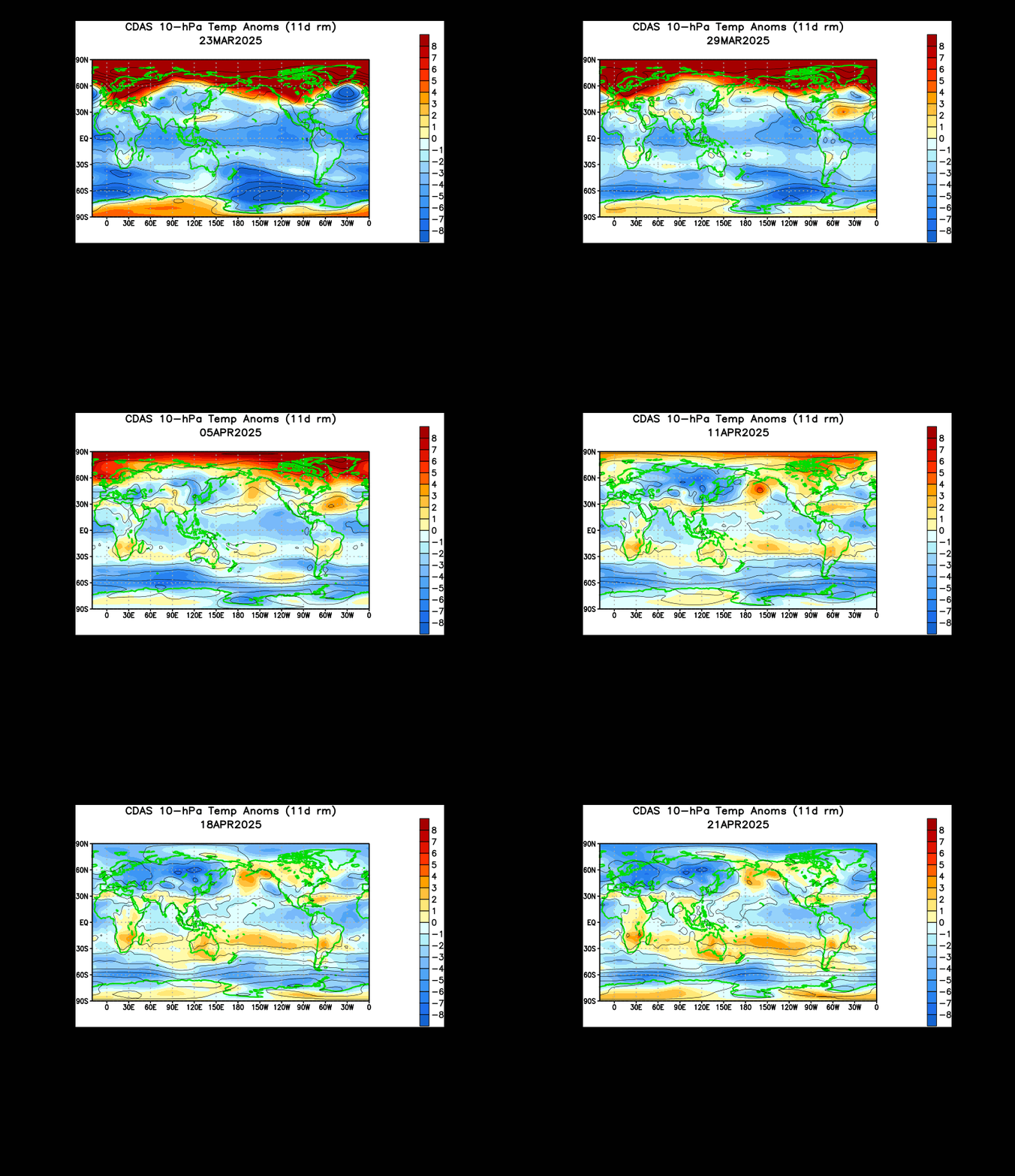
But we're not just watching for a powerful winter storm- we're watching for potentially significant cold!

CPC
The animation above shows temperature anomalies at the 10 millibar level, in the far upper reaches of the stratosphere, over the past month or so. According to this animation, we recently saw a very early stratospheric warming event overtake the Eurasia and North Pacific basin. If we remember that the warmth in the stratosphere typically results in very cold weather at the surface about 2-4 weeks later... put the pieces together, and we could very well see a strong body of cold air intercept this potentially significant winter storm system, making for one heck of a situation that could unfold.

Let's summarize all of this.

- Confidence is growing in the threat of a near-record-breaking extratropical storm system impacting the Bering Sea.
- If this forecast goes as planned, a powerful storm system would be expected to traverse North America around or just after Thanksgiving.
- Abundant cold air provided by the stratospheric warming may enable a larger threat of snow, if such a threat does evolve.
- A high amount of uncertainty still exists with this storm potential, hence the continued caveat-laced language in these posts.

Andrew 

Monday, November 3, 2014

Thanksgiving Potentially Significant Winter Storm

This is an update to yesterday's post, discussing a potentially significant winter storm in the November 24-30 timeframe.

Tropical Tidbits
The image above shows the ECMWF 500mb geopotential height values in color, with superimposed mean sea level pressure (MSLP) values and appropriated high/low pressure marks. In this image, valid for November 8th over the West and North Pacific basins, we see an incredibly strong extratropical storm circulating over the far western Aleutian Islands, with a minimum SLP value of 920 millibars.

To give you an idea of how strong this reading is, if this forecast from the most prestigious weather model in the world were to verify, we could very well break the record for the lowest extratropical minimum SLP value ever recorded (the lowest SLP value ever belongs to Typhoon Tip, with 870 millibars, but that was a tropical system). But the most intriguing thing?

It could actually happen.

This whole process looks to begin with the remnants of Typhoon Nuri, currently offshore Japan, which will race northeast and quickly strengthen as it approaches the Bering Sea. While storm systems tend to strengthen in the Bering Sea, this one may strengthen much faster and even stronger than most due to that tropical component from Typhoon Nuri.

But wait! Why should we care about this? What about the Thanksgiving storm? The potential for a significant winter storm evolves out of the Bering Sea for this forecast. The method, referred to as the Bering Sea Rule, takes the occurrence of high and low pressure events in the Bering Sea, and expects a similar weather phenomenon to occur in the US about 17-21 days later. This is almost exactly like the Typhoon Rule I commonly discuss when analyzing winter storm potentials, except now the area to watch is the Bering Sea, and the timeframe from occurrence in the Bering Sea to reciprocation in the US is now 17-21 days. Therefore, if we take the storm in the image above (valid on 11/8) and extrapolate it out using the BSR guidelines, we come up with a potentially significant storm in the November 25-29 period, give or take a day or two.

Tropical Tidbits
This next graphic above shows the same 500mb height values and superimposed MSLP values over the West Pacific, like the ECMWF model forecast, but now from a different model. This is the GFS-Parallel model, rumored to be the next-generation forecasting model that will soon replace the GFS model. For the time being, this is an experimental model, and won't become operational for another month or two, but it's still worth using for examination purposes.

Here, we see in this forecast for November 8th, the minimum SLP is down to 914 millibars. That's about 6 millibars stronger than the ECMWF forecast, and indicative of a likely-record-breaking storm, but the premise remains the same. Both model guidance systems are showing a very strong storm system in the Bering Sea in this November 8th timeframe. If you're a true analyst, you might notice that the GFS-parallel forecast is just a bit east of the ECMWF forecast. That does make a difference in this forecast, and I'll explain it a bit later in this post.

Tropical Tidbits
In the spirit of including the old with the new, we'll go over the currently-operational GFS model and its forecast. Here, we see the projection for November 8th calls for a 923 millibar cyclone to hit the Bering Sea. This is the weakest of the three forecasts we've analyzed thus far, but that's a pretty odd thing to say when the weakest member of the three is "only" at 923 millibars. Despite the slightly weaker outlook, the consensus is still for a very strong, possibly record-breaking storm to hit the western Bering Sea.

Tropical Tidbits
Lastly, to show I'm willing to include all angles and not, as some may accuse, only the strongest projections, we'll go over the ECMWF ensemble set. The ECMWF ensembles, commonly called the most accurate ensemble set in the world at this time, are forecasting a minimum SLP of 947 millibars for this storm system on November 8th.

If you aren't sure how to interpret this, I'll sum it up: WOW!

Ensemble guidance is composed of a number of 'members', or versions of the original model that have been slightly altered, intentionally, to produce a 'spread', or variation, in the forecast. This then adds accuracy to the forecast. It's very surprising to see a set of ensembles - from the ECMWF, no less - to be calling for a 945mb storm to strike the Bering Sea. This average of 52 - yes, fifty-two separate ensemble members - indicates that certainty for such a strong storm to hit the north Pacific is on the rise. It's quite plausible we see this minimum SLP from the ECMWF ensembles drop in future runs.

But we're not just watching for a powerful winter storm- we're watching for potentially significant cold!

CPC
The animation above shows temperature anomalies at the 10 millibar level, in the far upper reaches of the stratosphere, over the past month or so. According to this animation, we recently saw a very early stratospheric warming event overtake the Eurasia and North Pacific basin. If we remember that the warmth in the stratosphere typically results in very cold weather at the surface about 2-4 weeks later... put the pieces together, and we could very well see a strong body of cold air intercept this potentially significant winter storm system, making for one heck of a situation that could unfold.

You might have noticed a combination of rather ominous language about the storm, as well as more than a few caveats. Both are well warranted, as we'll have to wait and see if this storm ends up being as strong as projected in the Bering Sea.

To summarize:

- The potential exists for a significant winter storm around Thanksgiving.
- With stratospheric-induced cold air possibly intercepting this storm, winter weather may be a serious issue to contend with.
- High uncertainty still exists, but appears to slowly be waning.
- As of now, the Central and East US look to be affected by this storm (i.e. Midwest, Great Lakes, Ohio Valley, Northeast...).

Andrew

Sunday, November 2, 2014

November 24-30 Potentially Significant Winter Storm

It's becoming evident that we may be dealing with a potentially very strong Thanksgiving winter storm.

Tropical Tidbits
The image above shows the GFS model's combined forecast of 500mb geopotential height values (colored shadings) and mean sea level pressure (MSLP) contours over the West Pacific and north-central Pacific basins. High and low pressure demarcations are also seen. This forecast is valid on the evening of November 7th, and may have a significant effect on our weather here.

The potential for a significant winter storm evolves out of the Bering Sea for this forecast. The method, referred to as the Bering Sea Rule, takes the occurrence of high and low pressure events in the Bering Sea, and expects a similar weather phenomenon to occur in the US about 17-21 days later. This is almost exactly like the Typhoon Rule I commonly discuss when analyzing winter storm potentials, except now the area to watch is the Bering Sea, and the timeframe from occurrence in the Bering Sea to reciprocation in the US is now 17-21 days.

Getting back to this model forecast, we can see a very strong extratropical cyclone impacting the far western Aleutian islands, with a minimum central pressure of 930 millibars. If we utilize the Bering Sea Rule here, and extrapolate the forecasted time frame above of November 7th out seventeen to twenty-one days, we find ourselves with a potentially significant winter storm in a rough November 24-30th timeframe.

The evidence supporting this storm doesn't end here; we have a long way to go...

Tropical Tidbits
The model now shown above is the Canadian GEM forecast model, with the same 500mb geopotential height and MSLP contour parameters as the GFS model (for future reference, all model guidance we will analyze here today will use those 500mb and MSLP parameters). This forecast is valid on the afternoon of November 8th, nearly a day later than the GFS forecast above. Despite this time difference, we still see that very strong storm system from the GFS model now appearing in the GEM's forecast, with a minimum central pressure of 944mb spread across a heavy majority of the Bering Sea. Once again, this supports the prospect of a strong winter storm, if not solely a strong blast of cold air, to the US in late November.

Tropical Tidbits
Let's now examine the ECMWF model, commonly referred to as the most accurate weather model in the world at this time. The forecast panel above is valid for the evening of November 7th, and even though the storm hasn't reached the Bering Sea yet, its minimum central pressure is already down to whopping 930 millibars!

Tropical Tidbits
If we fast forward that same ECMWF model forecast up twenty-four hours to the evening of November 8th, we find that the storm system has gotten a bit stronger, and quite larger. The minimum central pressure is now down to 928 millibars, with the storm's influence spread from Russia to Alaska! The ECMWF model joins the GFS and GEM in supporting a strong winter storm for late November, possibly in time for Thanksgiving.

I could keep adding more and more model guidance projections to prove my point, but the general premise is already pretty clear by now. The three aforementioned models, in conjunction with the GFS-Parallel, ECMWF ensembles, and GFS Ensembles are favoring a very strong storm system in the Bering Sea for around November 7th or 8th.

The next question becomes, who could it target?

Well, if these model forecasts do verify as they appear now (which is nowhere from certain), each model projection would hit a difference part of the nation. The forecast members with the storm further west in the Bering Sea would find the Thanksgiving storm system in the Central US, while the model guidance members further east into the middle Aleutian Islands (or even further east) would likely find the consequential Thanksgiving timeframe storm in the East US, possibly along the coast.

Because this potential storm is still over 7 days away from appearing in the Bering Sea, and thus guidance can be expected to change with uncertainty, it's not worth putting down an accurate estimate as to where the storm may hit. However, just glancing over trends from these three shown models, as well as others available, would only slightly support more of a Central US/inland East US storm system.

To summarize:

- Model guidance is favoring a very strong storm to hit the Bering Sea in the next few days.
- If this storm ends up as strong as projected, it may result in a very strong winter storm around the Thanksgiving timeframe.
- A lot of uncertainty exists with this storm at this time.

Andrew

Wednesday, September 10, 2014

Multiple Arctic Blasts Projected to Hit North America During Coming Weeks

The remainder of September into October looks to feature a series of Arctic cold shots, potentially record-breaking at times.

Tropical Tidbits
Click to enlarge
The first cold threat looks to arrive only in a matter of days after our ongoing cold shock. Shown above is the GFS ensemble forecast over the Western Pacific, showing expected 500mb geopotential height anomalies. Reds indicate above normal height anomalies, consequentially warmer and quiet weather. Blues depict negative height anomalies, which often result in cold and stormy weather. 

In the image above, valid September 11th, we see a swath of negative height anomalies overtaking Japan as a rather strong upper level low scrapes the nation to the north. Seems pretty mundane, sure, but the consequences here at home are far more than mundane. As has been discussed consistently for the past couple of years, the weather in East Asia can have a significant impact on weather here in the United States. Utilizing the East Asian correlation of ridging over Japan equals ridging in the US 6-10 days later, and the same situation with negative height anomalies, we can foresee long range weather patterns weeks out at a time. This mechanism is referred to as the Typhoon Rule, and states that weather patterns found at the 500mb level can replicate themselves over North America 6-10 days later after they appear over Japan. 

 If we use this rule on the model image above, a rather strong upper level low with the accompanying threat of some cold Arctic air may begin affecting the US around September 17-21st, within the six-to-ten day timeframe discussed above.

Tropical Tidbits
The image above once again shows forecasted 500mb height anomalies over the West Pacific, now valid on September 18th. Again, we see another swath of negative height anomalies over Japan, apparently due to another strong upper level low pressing south into the northern part of the country.

Using the aforementioned Typhoon Rule, it appears our second cold blast may impact the country around a September 24-28th timeframe. This one may be more significant than the last, as ensembles are already highlighting well below normal height anomalies this far out, and the upper level low appears deeper and more pronounced than the one in our first Arctic air threat.

Plymouth State
Our third threat at Arctic air follows closely behind our second threat. The image above, from Plymouth State University, shows the ECMWF model's forecast of 500mb heights (shaded colors and white contour values) and mean sea level pressure (MSLP) values (black lines). In this image, valid September 13th, we see a strong upper level low placed over the eastern Bering Sea. Just as we saw in Japan, this appears rather mundane, but actually plays a significant role in our upcoming weather.

By observing trends in the Bering Sea, weather conditions in the US can be predicted 17 to 21 days in advance. For instance, if the Bering Sea experiences a deep storm system, cold weather may be expected 2.5 to 3 weeks later. The same goes for high pressure in the Bering Sea. In this case, with the forecast above valid on September 13th, we may expect a rather significant cold blast over the United States for the end of September and into October, in a general September 30th - October 4th time period.

Plymouth State
It's this last Arctic air threat that has me concerned. The image above once again shows the ECMWF's outlook of 500mb heights and MSLP values, now valid on September 17th. In this image, we see decidedly below-normal heights spread across nearly the entire Bering Sea, with the core of this messy trough centered just north of the Aleutian Islands.

This scenario worries me a bit. Even though this is definitely a long range forecast (and thus shouldn't be seen as high-certainty), the premise is concerning. The ECMWF's proposition of a cold air mass across the entire Bering Sea would suggest more of a long-term cold weather period, across a big chunk of the nation. Extrapolating the forecast time period of September 17th, we might expect some cold weather around an October 4th - October 8th period, possibly for longer.

A short-term warm-up can be expected in the last week or two of September before the cold continues.

Stay tuned for continuing updates on these threats.

Andrew

Tuesday, May 13, 2014

Summerlike Warmth Returns for First Days of June

I'm expecting summerlike warmth to come back for the first week or so of June.


The image above shows projected 500mb height anomalies over the northern hemisphere. We can signify the blues with negative height anomalies, which indicate the presence of cooler and stormier weather, while reds denote positive height anomalies, which allow for warmer than normal and calm weather. In the image above, if we look towards the Bering Sea, we can see a very strong ridge of high pressure, seen by the splotch of red around the Aleutian Islands. This image is valid for May 13-14, and if we extrapolate it out 2-3 weeks using the Bering Sea Rule, we can expect high pressure and warm weather to appear in the East US.


If we look at another 500mb height anomaly forecast graphic, this one valid on May 19th, we now see that our strong ridge has shifted west into the middle of the Bering Sea, with cooler, stormier weather now protruding into western Alaska. This tells us that we can expect warm temperatures in the first several days of June in the middle of the country, with cooler conditions along the Eastern Seaboard.

This warmth is supported by long range modelling of enhanced tropical convection around the central Pacific, which is typically associated with warmer than normal weather in the Central and East US in the May-June-July time period. The bottom panel in the graphic above demonstrates the enhanced convection (blue) present in the Central Pacific.

Andrew