Tuesday, December 1, 2015

Upper Stratosphere Experiencing Minor Warming

The upper stratosphere appears to be undergoing some minor warming, although it is unlikely to set up a polar vortex disruption event.

CPC
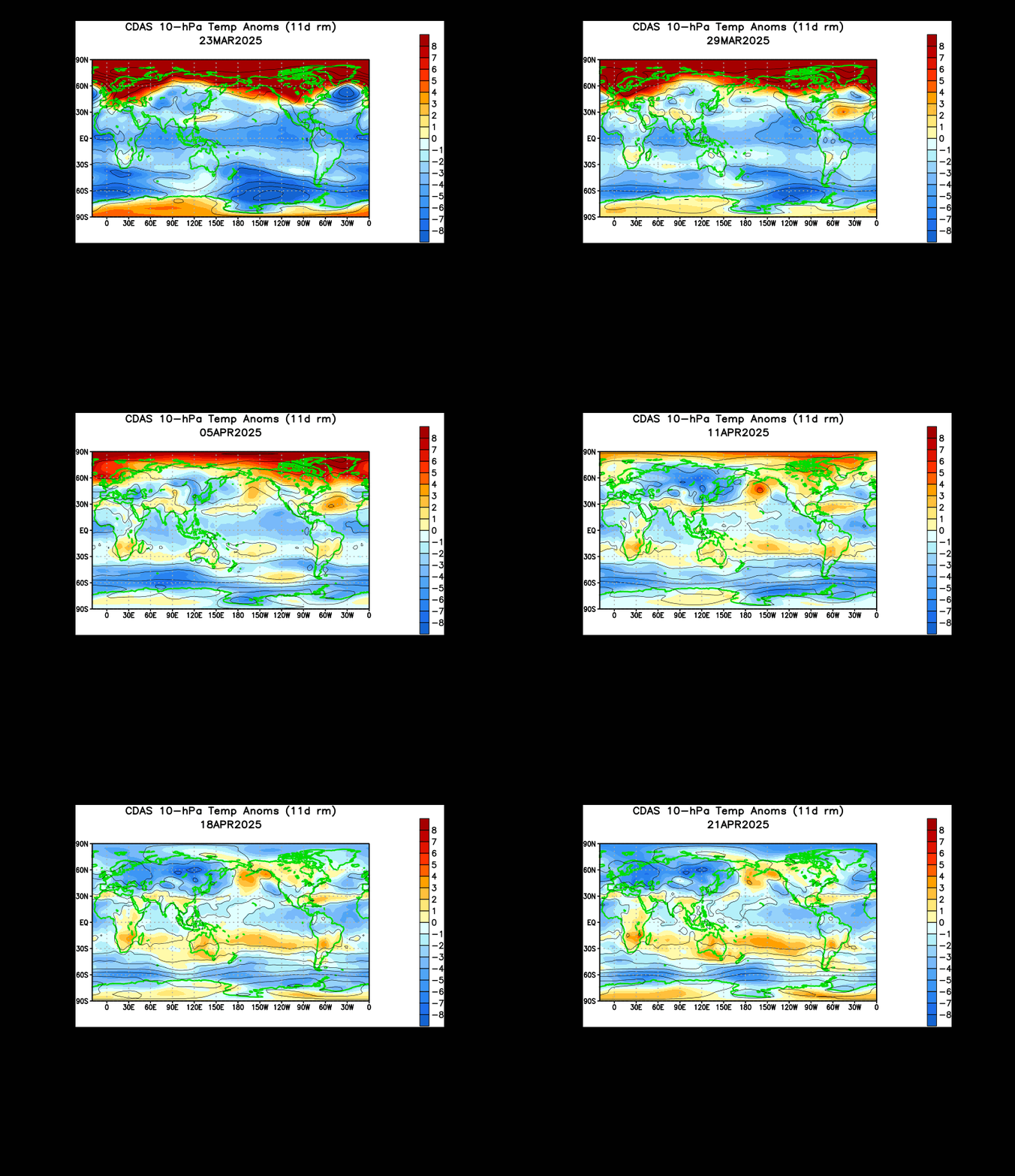
The above animation shows temperature anomalies at the 10-hPa level of the atmosphere, in the upper levels of the stratosphere, over the last month. Beginning around November 20th, we started to see increasing temperatures just east of Japan, which really amplified in strength around November 27th. They aren't really moving in a particular direction, although a slight northward push has been noted over the past couple weeks.

CPC
This warming is likely thanks in part to a substantial increase in north poleward eddy heat flux values since about the last two weeks of November, right at the time when we started to see that warming commence in the 10-hPa layer. Typically, increased eddy heat flux values reflect an increased movement of warm air from the lower latitudes to the poles. Higher values can precede or coincide with stratospheric warming events, which is likely why we're seeing warming at the 10-hPa and 30-hPa levels.

CPC
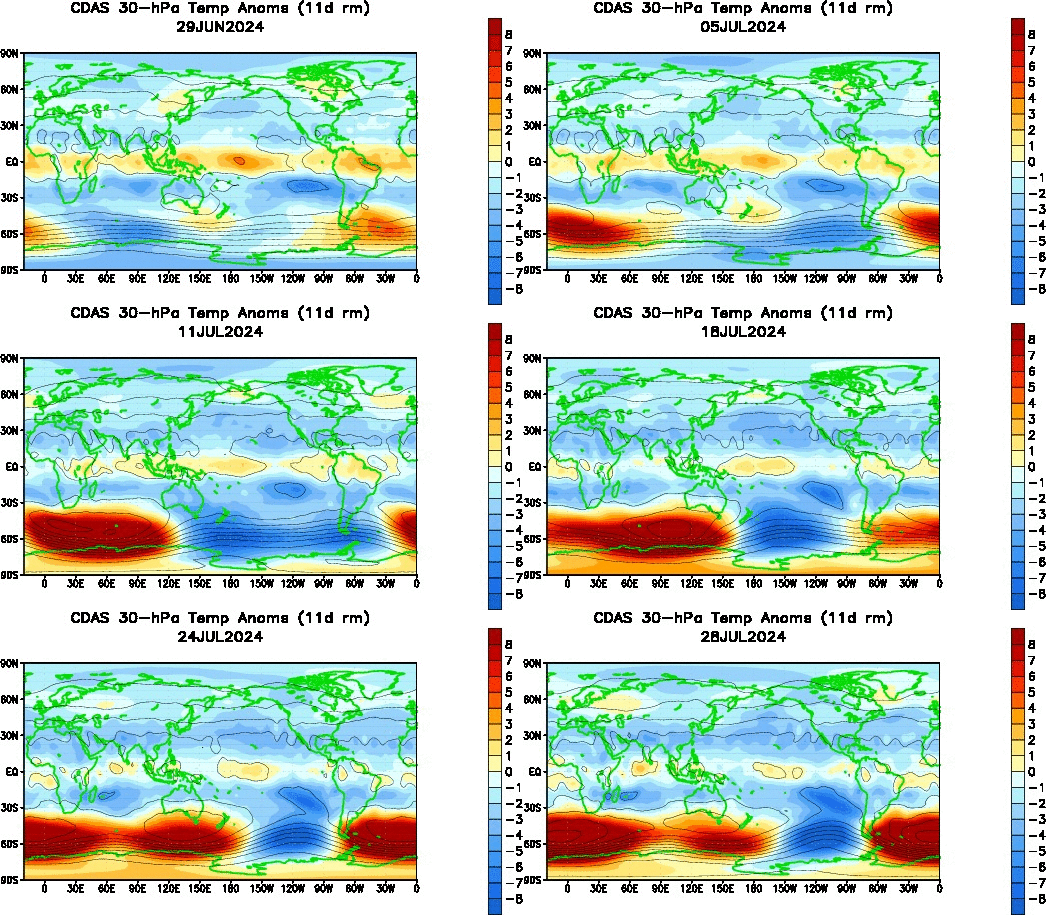
The 30-hPa level, just a bit higher than the middle of the stratosphere, is showing some warming, albeit deflected a bit further east than the 10-hPa warming. In addition, this 30-hPa warming is showing an eastward push, rather than a poleward push. The latter would be more favorable for a polar vortex disruption event / stratospheric warming, so winter weather fans may not be too encouraged to see this.

To summarize:

- Minor warming is being observed at the 10-hPa and 30-hPa levels of the stratosphere.
- This warming is not strengthening quickly and is not making a strong poleward movement, so a stratospheric warming event is not expected over the next several days.

Andrew

Thursday, November 26, 2015

Long Range Forecast (Posted 11/26/15)

This is the long range forecast, published on 11/26/15.


 The 500mb pattern over the last week showed a dominating ridge in the Gulf of Alaska, leading to negative geopotential height anomalies in central North America. This was exhibited by the strong storm system(s) that passed through the region since our last outlook.

 500-millibar chart shows a strong upper level low stationed over the Southwest, as the closed blue contours indicate. Southerly lower-level winds are advecting moisture northward into the Plains and Midwest, which will serve to kick off wintry weather on Thanksgiving.

 Polar water vapor imagery shows an active pattern in the North Hemisphere. We see two upper level lows with a Rossby Wave signature in the Gulf of Alaska, as well as another upper level low impacting the Aleutian Islands. Hurricane Sandra is shown near Mexico, and this will deliver moisture to the US later on.

 Analysis of the jet stream shows how the upper level low to the southwest of the Gulf of Alaska will likely be cut off from the jet stream in the near future, while a strong jet streak plows into the Pacific Northwest. Another jet streak pressing northwest of Arizona to the southeast of the trough tells us the upper level low in the Southwest is preparing to eject eastward. We also see another jet streak ribbon exiting Japan, which should provide us with a storm opportunity about 7-10 days down the road.

 Current tropical forcing across the globe shows upper level divergence from the area east of Madagascar, as well as northeast of Australia. This forcing pattern in the central Pacific is typically favorable for warmer weather, although additional convection near Africa helps dilute its influence so forcing is not too useful in its current position.

 Expecting a re-amplification of the pattern over the next 7-10 days as we see increased storm chances. Watch for a moderation in temperatures over the next several days, as tropical forcing indicates the atmosphere will be favorable for generally warmer than normal weather.

Storm concerns … potential storm monitored for 12/2 – 12/6. Increased risk for stormier than normal pattern about 12/5 – 12/15, though confidence is low.

 Continuing with previous outlook, conditions do still look somewhat cooler and stormier around the Christmas timeframe. New Years Day and the first week of 2016 should see a departure from this cooler/wetter pattern back into more moderated temperatures.

The Next Long Range Outlook will be published on December 2nd, 2015 at 5:00 PM CDT.

Andrew

Thursday, November 19, 2015

Long Range Forecast (Posted 11/19/15)

This is the long range forecast published on November 19, 2015. 


Over the last seven days, we’ve seen strong negative geopotential height anomalies over the Gulf of Alaska, leading to ridging in Canada and a warmer pattern here in the U.S. A strong storm system is currently moving out of the United States, showing the reasoning behind that small swath of negative anomalies in the Plains.

The SLP map (brown lines) and 500mb contours (blue lines) show our upper level low finally moving off into Canada, with the cold front continuing east into the East US, as infrared satellite presentation shows.

Water vapor imagery over the North Hemisphere shows a strong Pacific jet stream blasting into the Pacific Northwest, delivering the next chance at active weather. We also see an upper level low in the Bering Sea, which is expected to contribute some energy to our pattern over the next week or two.

Analysis of the jet stream over the Northern Hemisphere shows a rather inactive pattern in the North Central Pacific, but a strong jet streak or two over East Asia indicate the potential for some stronger storm systems over the next 10-20 days in the United States.

Current tropical forcing imagery over the globe shows strong divergence across Central America into the United States. Additional divergence is seen in southern Africa and near India. This pattern is conducive to cooler conditions in the United States (Phase 8-1 MJO).

Pattern should quiet down over Thanksgiving, with tropical forcing moving into areas more favorable for warmer weather for much of the country into the opening 5-10 days of December. Heading into mid-December, tropical forcing should re-organize in a pattern more favorable for cooler weather in the United States.
Storm concerns… Anticipating storm system around 11/20 – 11/25. Watch for a potential storm system around 11/30 – 12/5, as well as a second system around 12/4 – 12/9.

Early analysis of pattern around Christmas does favor another round of stormy and cooler weather in time for the holidays. Tropical forcing indicates we may need to monitor for a significant storm system not unlike the one currently moving into Canada, which brought tornadoes and heavy snow to the Central US this past week.

Next Long Range Outlook
November 26th, 2015 at 5:00 PM CDT

Andrew

November 20-22 Potentially Significant Winter Storm

Model guidance continues to increase snowfall amounts in the winter storm expected to impact Friday through the weekend.

Instant Weather Maps
The latest GFS model has shifted snowfall amounts further to the north since we last analyzed the system yesterday. We now see forecasted totals in the 3-6" range across northern Nebraska into extreme southern South Dakota. Amounts in the 6-10" range are then forecasted in most of Iowa, with lesser amounts in the southern portion of the state. Amounts exceeding 12" are projected to hit southern Wisconsin, including Madison and Milwaukee. Northern Illinois experiences an intense gradient, with the city of Chicago receiving under 3" and areas along the Illinois-Wisconsin border receiving 12".

Instant Weather Maps
The latest NAM model takes a different approach to the storm. It drops 3-10" across southern South Dakota, with the lower end of the gradient in the western portion of the state and heavier amounts in the eastern part of the state. Northeast Nebraska is in line for 6-10" of snow according to this model, with a sharp gradient to the south of that heaviest snow axis. Iowa is projected to be slammed with snow across the board, with heaviest amounts in the western and northern portions of the state. Amounts then drop off as the storm moves into the Midwest. 6-8" amounts are forecasted to hit in a thin line along the Illinois-Wisconsin border, heading right into downtown Chicago, Illinois. Lesser amounts in the 3-6" range are then found in southern and central Michigan.

To summarize:

- A potentially significant winter storm is expected to impact the Plains, Midwest and Great Lakes Friday into Sunday.
- Considerable uncertainty still exists with respect to the track of this system.
- Amounts in excess of 6" are possible, especially in Iowa, southern Wisconsin, and northern Illinois.

Andrew

Thanksgiving Potential Wintry Storm System

There does appear to be at least a chance of a wintry storm system in the Thanksgiving timeframe.

Tropical Tidbits
The GFS model has a messy solution evolving for Thanksgiving Day, as the above image shows. We see two centers of low pressure, one on the Oklahoma/Colorado/Kansas border, and another on the South Dakota/North Dakota/Minnesota border. They are both about the same strength, with the southern one at 1004 millibars and the northern one at 1005 millibars. The graphic here shows widespread (albeit light) snowfall in Montana and North Dakota, with heavier snowfall in eastern North Dakota near the low pressure system.

In the warm sector, we see a line of rain and thunderstorms extending from southern Texas through Oklahoma, Missouri, and into Wisconsin and Minnesota. Going by this image, it's possible we see some stronger storms in the Texas and Oklahoma areas, into Arkansas as the day continues. Heavy rain would still be possible in the Midwest and Great Lakes, making for a soggy Turkey Day for locations such as Chicago, Milwaukee, St. Louis, and Little Rock.

Tropical Tidbits
The GEM model shows a singular storm system placed in southeast Oklahoma in the early morning hours of Friday, immediately after Thanksgiving. This would include heavy rain, and possibly thunderstorms, in Missouri, Arkansas, and along the Gulf Coast. Lighter rain would be anticipated in Iowa and Illinois, while a rain-to-mix solution could evolve for Kansas, Nebraska, and Iowa. A snow-mix situation would unfold across the Upper Midwest and North Plains. It's too early to talk accumulations, especially since there is no model agreement on strength, track, and precipitation.

To summarize:

- Model guidance is indicating the chance for a wintry storm system on Thanksgiving Day.
- Low confidence still exists in this situation.

Andrew